

Trajectory of a Law Professor
Women of color are already severely underrepresented in legal academia; as enrollment drops and legal institutions constrict further, race and gender disparities will likely continue to grow. Yet, as many deans and associate deans, most of whom are white, step down from leadership positions during these tumultuous times in legal education, opportunities have arisen for women of color to fill those roles in record numbers. However, there are individual and structural barriers preventing access to the leadership level. Significant hurdles have long prevented women of color from entering law teaching. Thus, this Article provides evidence to support the thesis that ongoing changes in legal education will likely continue to create barriers both to entry and advancement for women of color law faculty members and those who aspire to join legal academia. This Article draws from quantitative and qualitative analyses of data drawn from the Diversity in Legal Academia (DLA) project, a landmark mixed-method study of law faculty diversity, which utilizes an intersectional lens to focus on the experiences of women of color in legal academia while also incorporating those of white men, white women, and men of color. Empirical findings reveal that structural barriers (i.e., outright discrimination) as well as more indirect obstacles prevent women of color from joining legal academia in meaningful numbers and also preclude women of color who are already legal academics from taking on leadership positions. Law school administrators and policy makers should work against these structural and individual barriers to increase and improve faculty diversity at all levels. Greater diversity in legal academia generally, and leadership in particular, will not only provide greater opportunities for particular law faculty members, but will also have a positive effect on law students, legal education, legal academia, and the legal profession overall.
Introduction
In the coming years, there will likely be divergent paths leading to perils and opportunities for law professors, as well as the interdisciplinary, innovative, and progressive scholarship many of these faculty produce.1See, e.g., scholarship by critical race theorists Derrick Bell, Richard Delgado, Neil Gotanda, Mari Matsuda, and others in Critical Race Theory: The Key Writings that Formed the Movement (Kimberlé Crenshaw et al. eds., 1995). Current research on law school diversity has centered on the student experience, with little attention paid to academics.2Meera E. Deo, The Promise of Grutter: Diverse Interactions at the University of Michigan Law School, 17 Mich. J. Race & L. 63, 74-86 (2011) (discussing numerous student diversity studies). See also Walter A. Allen & Daniel G. Solórzano, Affirmative Action, Educational Equity & Campus Racial Climate: A Case Study of the University of Michigan Law School, 12 Berkeley LA RAZA L.J. 237 (2001); Carole J. Buckner, Realizing Grutter v. Bollinger’s “Compelling Educational Benefits of Diversity” – Transforming Aspirational Rhetoric Into Experience, 72 UMKC L. Rev. 877 (2004); Celestial S.D. Cassman & Lisa R. Pruitt, A Kinder, Gentler Law School? Race, Ethnicity, Gender, and Legal Education at Kind Hall, 38 U.C. Davis L. Rev. 1209 (2005). However, as legal education undergoes significant changes, faculty diversity will be challenged too. With hiring freezes in place at many schools and institutions less likely to take risks on those without elite credentials or with divergent paths to the academy, faculty of color and female faculty are less likely to be hired as entry level tenure-track faculty.3See Ashby Jones & Jennifer Smith, Amid Falling Enrollment, Law Schools are Cutting Faculty, Wall St. J., (July 15, 2013, 4:39 PM), http://online.wsj.com/article/SB100014241 27887323664204578607810292433272.html. Lateral opportunities also appear increasingly scarce.4Dan Filler, Law School Lateral Faculty Moves 2014, The Faculty Lounge (Aug. 23, 2014, 4:06 PM), http://www.thefacultylounge.org/2014/03/law-school-lateral-faculty-moves- 2014.html.
If in addition to these external challenges, structural barriers block the hiring of nontraditional law faculty, the legal academy will become even more white and male. Statistics show that at least 71% of current legal academics are white and 62% are men.5AALS Statistical Report on Law Faculty, Race and Ethnicity (2009), Ass’n Am. L Schs., http://www.aals.org/statistics/2009dlt/race.html [hereinafter AALS Sta– tistical Report]. Yet, there may be increasing opportunities ahead as well. With significant numbers of administrative leaders—notably, deans and associate deans, most of whom are white— stepping down from formal leadership positions, senior faculty of color and female faculty may be poised to take on those roles in greater numbers.6See Jeff Schmitt, Deans at USC and Illinois Step Down, Tipping the Scales (May 6, 2014), http://tippingthescales.com/2014/05/deans-at-usc-and-illinois-step-down/ (“As another school year closes – and budgets and incoming classes take shape – April is often the time for weary academics to look at the big picture. With April reflections come May defections”). Their ascension could significantly increase diversity at the leadership ranks, as currently 83% of law school deans and 79% of associate deans are white.7Additional data on law faculty and staff diversity is available from American Bar Association, http://www.americanbar.org/groups/legal_education/resources/statistics.html (last visited September 9, 2014). Of course, if women of color faculty members are not prepared, willing, and interested to assume those positions, and are given fewer resources to succeed in these positions, there may be little actual advancement.
This Article focuses on both ends of the professional spectrum in legal academia: access to the most junior (assistant professor) tenure-track positions as well as opportunities at the most senior administrative leadership (dean) level. Empirical findings presented in this Article reveal that there are ongoing barriers to entry for women of color who are aspiring law faculty as well as more senior scholars who could assume leadership roles.8See discussion infra Section VI. Challenges include both structural barriers (e.g., discrimination) as well as individual obstacles (e.g., lack of interest) preventing women of color from succeeding as law faculty members.9See id. Yet, even the individual barriers have structural roots, as a lack of interest or failure to apply for leadership positions often comes from particular faculty members who are enduring an already challenging workplace climate, one that rarely values the paths, experiences, or suggestions of non-traditional faculty.10See id.
Ironically, law schools may be giving increasingly less attention to law faculty diversity at the very moment when they should be focused on improving recruitment and retention of individuals from underrepresented groups. Many schools are facing external challenges that force them to be “more student-centered, focusing more on skills-based learning, and creat-ing other incentives to attract students and keep them in school.”11Meera E. Deo, The Ugly Truth about Legal Academia, 80 Brook L. Rev. 943 (2015). They may be tempted, at the same time, to devalue diversity.
Yet, being more student-centered goes hand-in-hand with increasing and improving faculty diversity. Law students from all racial/ethnic back-grounds are especially connected to female faculty and faculty of color, appreciate the extra attention these faculty provide to all students, and specifically seek out nontraditional faculty for mentorship and support.12Meera E. Deo, Rican Vue & Maria Woodruff, Paint by Number? How the Race & Gender of Law School Faculty Affect the First Year Curriculum, 29 Chicano-Latino L. Rev. 1, 17 (2010). Exposure to diverse faculty also will better prepare students for future practice where they will likely encounter numerous colleagues, supervisors, and clients from backgrounds that differ from their own.13Exposure to diverse viewpoints from classmates is similarly crucial for optimizing success as legal practitioners, according to empirical studies of both law students. Compare Meera E. Deo, Empirically-Derived Compelling State Interests in Affirmative Action Jurisprudence, 65 Hastings L.J. 661, 689-90 (2014), and Meera E. Deo, Faculty Insights on Educational Diversity, 83 Fordham L. Rev. 3115 (2015).
In addition, newly revised American Bar Association (ABA) accreditation standards are especially direct about the requirement that accredited law schools provide equal employment opportunities to diverse faculty candidates and avoid discrimination against faculty and faculty candidates.14The ABA accreditation standards are available online at http://www.americanbar. org/groups/legal_education/resources/standards.html (last visited Sept. 10, 2014). For example, ABA Standard 205 (Non-discrimination and Equality of Opportunity) requires law schools to provide “equal employment opportunity . . . in regard to hiring, promotion, retention and conditions of employment.”15Standard 205(d), 2014-2015 ABA Standards and Rules of Procedure for Ap– proval of Law Schools at 11-12 (2014), available at http://www.americanbar.org/content/ dam/aba/publications/misc/legal_education/Standards/2014_2015_aba_standards_and_rules_of _procedure_for_approval_of_law_schools_bookmarked.authcheckdam.pdf. Law schools must also “foster and maintain equality of opportunity for students, faculty, and staff . . . without discrimination or segregation on the basis of race, color, religion, national origin, gender, sexual orientation, age, or disability.”16Id. at 205(b). ABA Standard 206 (Diversity and Inclusion) requires law schools to “demonstrate by concrete action a commitment to diversity and inclusion . . . by having a faculty and staff that are diverse with respect to gender, race, and ethnicity.”17Id. at 206(b). Furthermore, law schools are required to provide “full opportunities for the study of law and entry into the profession by members of underrepresented groups, particularly racial and ethnic minorities.”18Id. at 206(a).
Thus, improvements in faculty diversity are good practice to improve student recruiting and retention, make good sense to better prepare stu-dents for future legal practice, and may be required to be in compliance with the ABA requirements that schools demonstrate their affirmative commitment to diversity along various lines. In spite of these compelling incentives to improve law faculty diversity, this Article presents data confirming ongoing challenges diversifying law faculty at the entry level and leadership level. To that end, administrators should not just work harder, but also work smarter to diversify faculty, at both entry-level ranks and among leadership, utilizing the solutions presented in this Article as a starting point for improvement.
Part I of this Article outlines the relevant literature in the area, including background statistics on current law faculty members and a brief introduction to the small body of empirical literature on law faculty. Part II provides an introduction to the Diversity in Legal Academia (DLA) project, the first formal empirical study of the law faculty experience, utilizing an intersectional (race/gender) analysis to investigate similarities and differences in the personal and professional lives of law faculty from various backgrounds and across the career spectrum. The next three Parts present empirical findings from the DLA study. Part III reveals hiring challenges that serve as barriers to entry for women of color who aspire to become law teachers. Part IV discusses obstacles preventing women of color from assuming formal leadership positions in law school administration. Part V then presents findings on solutions to identified challenges, proposing specific methods to improve recruitment and retention of women of color law faculty and diversification of law faculty leadership. The Conclusion states implications of this research, indicating how diverse faculty and diverse leadership could improve legal education overall.
I. Taking the Temperature: Vital Signs in Legal Academia
This Part covers recent statistics on women of color in legal academia, the few published studies of legal academics, and background on current challenges and opportunities in legal academia that serve as the bases for the DLA project.
A. AALS Statistics According to the most recent statistics available, women of color are
severely underrepresented in legal academia.19See AALS Statistical Report, supra note 5. The 772 women of color legal academics (out of 10,965 law faculty members) comprise just 7% of the total (see Table 1 below).20Id. Because the Association of American Law Schools (AALS), the principal non-profit legal institution focused on supporting legal education, stopped releasing statistics on law faculty five years ago, it is unclear how immediate challenges in legal education have affected faculty diversity and will continue to affect it in the future.21See Ass’n Am. L Schs., http://www.aals.org (“AALS is a resource for the improvement of the quality of legal education by networking law school faculty, professional staff and deans to information and resources . . . AALS is the principal representative of legal education to the federal government, other national higher education organizations, learned societies and international law schools.”) (last visited Mar. 3, 2015). Yet, we can make some educated assumptions. With declining law student enrollment, few law schools are hiring faculty.22See Thomas M. Cooley Law School Statement, available at http://www.cooley.edu/ news/statement.html (last visited July 24, 2014). See also Retrenchment at Thomas Cooley Law, The Faculty Lounge http://www.thefacultylounge.org/2014/07/retrenchment-at-thomas-cooley -law.html (discussing Cooley’s announcement regarding “faculty and staff layoffs and other cut-backs”); Luz Herrera, Educating Main Street Lawyers, 63 J. Legal Educ. 189, 209 (2013); Brian Z. Tamanaha, Failing Law Schools (2012); Philip G. Schrag, Failing Law Schools – Brian Tamanaha’s Misguided Missile, 26 GEO. J. LEGAL ETHICS 387, 408 (2012). Some have begun encouraging early retirement and even firing law professors.23See sources cited, supra note 22. Thus, today’s actual statistics of diverse faculty are likely lower than they were five years ago. In addition, the AALS data includes not only tenured and tenure-track faculty, but also visiting faculty, adjuncts, lecturers, and those on short- and long-term contracts.24See Ass’n Am. L Schs., http://www.aals.org/statistics/2009dlt/titles.html (listing faculty by title, including lecturers, librarians, and instructors) (last visited Jan. 6, 2014). As a result, the 7% figure is likely over inclusive when considering tenure-track faculty, as women of color tend to be concentrated in lower-status roles rather than occupying tenured or tenure-track positions.25Donna Young, Two Steps Removed: The Paradox of Diversity Discourse for Women of Color in Law Teaching, 2 Afr.-Am. L. & Pol’y Rep. 270, 271 (1995) (female law faculty of color often “began teaching at significantly lower ranks than the minority men, obtained positions at significantly less prestigious schools, and were significantly more likely to teach low-status courses like legal writing or trusts and estates.”) (internal citation marks omitted).
Table 1. Law Faculty, by Race and Gender, AALS 2008-2009
(N-10,965) As shown in Table 1 and Chart 1, legal academia is amazingly homogenous with regard to racial/ethnic diversity, as almost three-fourths (71%) of all law professors are white.26Chart 1 removes those who do not identify their race/ethnicity, thereby comparing only white men, white women, men of color, and women of color. Gender disparities are also significant, as men comprise 62% of all law faculty members. Not surprisingly given these figures, white men are the intersectional race/gender group most represented in legal academia; almost half (46%) of all legal academics are white men.
Chart 1. Law Faculty,by Race & Gender, AALS 2008-2009
(N=6,740)
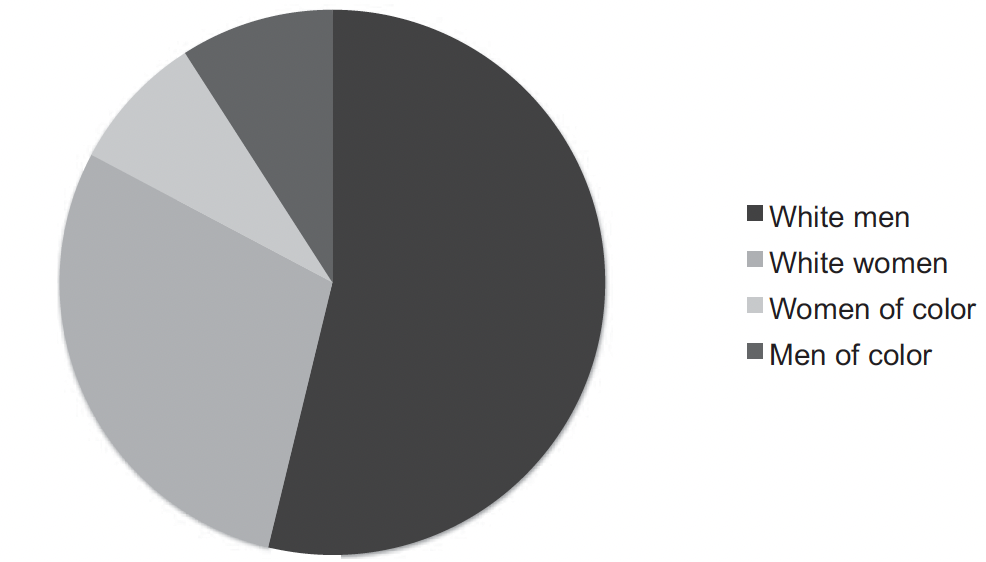
Of the 772 women of color legal academics, more than half (53%) are African American (see Table 2). Latinas comprise almost 18% of all women of color law professors, followed by Asian/Pacific Islanders (14.5%). Only twenty-one legal academics—out of 10,965—are Native American women.
Table 2. Women of Color Law Faculty, by Race, AALS 2008-
(N=772)
| N | % | |
|---|---|---|
| American Indian or Alaskan Native | 21 | 2.7 |
| Asian or Pacific Islander | 112 | 14.5 |
| Black/African American | 409 | 53.0 |
| Hispanic/Latino | 138 | 17.9 |
| Other Race | 34 | 4.4 |
| More than one race | 58 | 7.5 |
| TOTAL | 772 | 100 |
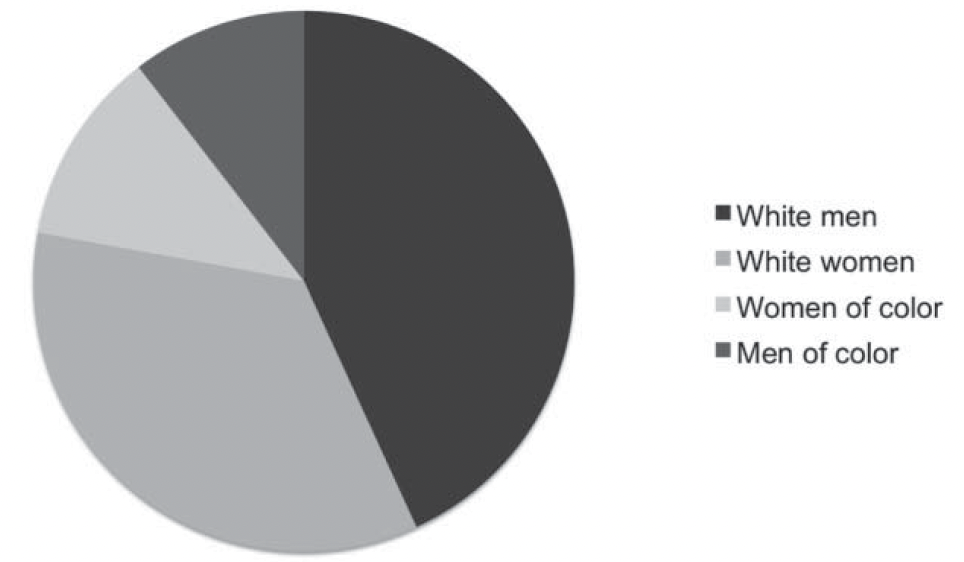
These disparities, while significant when we look at legal academia as a whole, are even more pronounced at the leadership level. ABA statistics show that, 83% of law school deans and 79% of associate deans are white.27Additional data on law faculty and staff diversity is available from the ABA website at Law School Faculty & Staff by Ethnicity and Gender, American Bar Association, http:// www.americanbar.org/groups/legal_education/resources/statistics.html (last visited September In addition, when looking intersectionally at race and gender, there are even more disturbing disparities (see Chart 2). A full 59% of deans are white men, representing 119 of the 202 law school deans in the United States.28Id. At the time this Article was going to press, there had been notable progress in the number of white women, women of color, and men of color deans, validating one thesis of this Article—that traditionally underrepresented law faculty members may be poised to take on leadership roles as the white men who tend to occupy those roles step down. See Karen Sloan, Female Deans Taking Charge: They Make Up 40 Percent of Incoming Leadership, Nat’l Law J. (June 22, 2015), available at: http://www.nationallawjournal.com/id=1202730008416/Female-Deans- Taking-Charge?slreturn=20150607125952 (last visited July 7, 2015). White women represent 20% of all law school deans. Yet, just 8% of deans—seventeen individuals total—are women of color from any nonwhite racial/ethnic background.29Id. If we look at leadership as a whole, col-lapsing categories of dean and associate dean, diversity improves significantly (see Chart 3). Including both categories of leaders, with white women representing 35% of all law school leadership and women of color representing 12% of leaders.
Chart 2. Law Deans,by Race & Gender, ABA 2013 (N= 202)
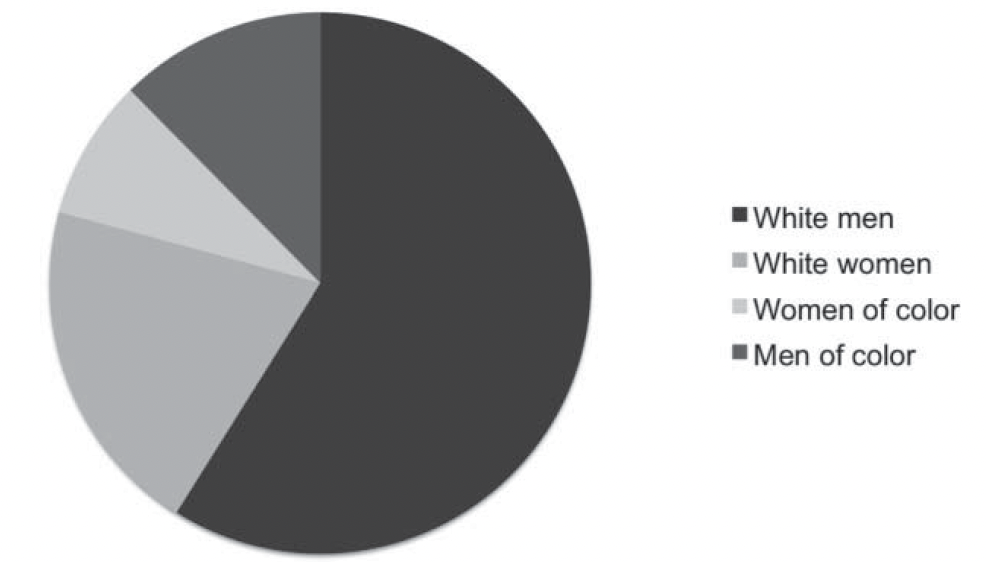
Chart 3. Law School Leadership,by Race & Gender, ABA
2013 (N=___)
B. Limited Research on the Law Faculty Experience
This glaring lack of diversity has attracted surprisingly little empirical research or scholarly attention. While there is some existing empirical research on law student diversity,30See Deo, supra note 2; Meera E. Deo et al., Struggles & Support: Diversity in U.S. Law Schools, 23 Nat’l Black L.J. 71 (2010); Cassman & Pruitt, supra note 2; see also Buckner, supra note 2. there has never been a systematic empirical analysis of law faculty diversity, analyzing the profession from assistant professor to leadership ranks31The few existing examinations of the law faculty experience are ungeneralizable, somewhat outdated, or incomplete. See, e.g., Richard Delgado and Derrick Bell, Minority Law Professors’ Lives: The Bell-Delgado Survey, 24 Harv. C.R.-C.L. L. Rev. 349 (1989); Katherine Barnes & Elizabeth Mertz, Is It Fair? Law Professors’ Perceptions of Tenure, 61(4) J. Legal Educ. 511 (2012). and focused on intersectional race/gender effects.32Intersectionality is “a product of Critical Race Theory suggesting that particular individuals exist at ‘an intersection of recognized sites of oppression.’” Meera E. Deo, Looking Forward to Diversity in Legal Academia, 29 Berkeley J. Gender L. & Just. 352, 355 (2014). Thus, the experiences of women of color, especially in the traditionally white male normative space of legal academia, will likely be different from those of white women, as well as men of color and white men. Only a handful of projects over the past twenty-five years have sought to investigate the law faculty experience, with any attention given to diversity and women of color.
In 1986, the University of San Francisco gathered many of the leading law faculty of color together to share their experiences.3320 USF L. Rev. 383 (1986) (symposium on minority law faculty). Remarks from that conference were later published in a symposium in the University of San Francisco Law Review.34Id. That volume includes pieces from some of the founding scholars of color in legal academia, including many of those who initiated Critical Race Theory as a framework in law, sociology, and other disciplines: Derrick Bell, Richard Delgado, Roy Brooks, and Rachel Moran, among others.35Id. They offer perspectives on the struggles of faculty of color in legal academia at the time and suggestions for how to improve the numbers generally and the quality of their experience in the future.36Id. One theme from the symposium is the lack of representation in legal academia at that time; for instance, 30% of law schools reported that they had no faculty of color on the tenure-track, and 10% of law schools con-sisted of at least 95% male faculty.37Rachel F. Moran, Commentary: The Implications of Being a Society of One, 20 U.S.F. L. Rev. 503, 504-05 (1986). The quality of the experience was also abysmal, with parallel research indicating a negative institutional attitude toward faculty of color generally.38See Richard H. Chused, The Hiring and Retention of Minorities and Women on American Law School Faculties, 137 U. Pa. L. Rev. 537-39 (1988) (discussing the tokenization of faculty of color on predominantly white law school campuses.
In 1992, Law Professors Derrick Bell and Richard Delgado built on the momentum from the University of San Francisco symposium to informally survey law faculty of color across the United States; they reported their results in a subsequent publication.39Delgado & Bell, supra note 31. Because Bell and Delgado had a very small response rate and non-systematic analysis, they confess that their findings are not generalizable; yet, the structural challenges they document are meaningful and seemingly widespread.40Id. at 353-54. For instance, law faculty faced “discrimination in hiring and promotion, alienation among their col-leagues, hostility from students, and a lack of support for their research.”41Deo, supra note 32, at 360-70 (citing Delgado & Bell, supra note 31) (internal citations omitted). Two main themes from that study are especially salient: (1) a lack of structural diversity42Structural diversity refers to “numerical representation of individuals with diverse backgrounds.” See Deo, Vue & Woodruff, supra note 12, at 7-8 n.21 (citing Sylvia Hurtado et al., Enacting Diverse Learning Environments: Improving the Climate for Racial/Ethnic Diversity in Higher Education, 26 ASHE-ERIC Higher Educ. Rep. Series 8 (1999)). in legal academia (e.g., low numbers); and (2) ongoing bias against law faculty of color (e.g., discrimination).43For more details on bias, privilege, and the intersectionality framework, see Deo, supra note 11.
Recently, the theme of challenges facing diverse faculty was explored further in Presumed Incompetent, a compilation of personal narratives, observations, and empirical research on women of color in academia across the disciplines.44See generally Presumed Incompetent: The Intersections of Race and Class for Women in Academia, (Gabriella Gut´ıerrez y Muhs, Yolanda Flores-Niemann, Carmen G. González, & Angela P. Harris eds., 2012). The main unifying theme, as evidenced by the title, is that women of color enter the profession with a presumption of incompetence working against them that serves as a preliminary barrier to success.45Id. at 1. That anthology includes challenges facing women of color academics in Sociology, Education, Law, Psychology, Engineering, and other disciplines.46See id. Presumed Incompetent raises concerns about bias in teaching evaluations, provides examples of blatant employment discrimination, and gives evidence of microagressions,47See id. at 1-14. the “subtle verbal and non-verbal insults directed toward non-Whites, often done automatically or unconsciously.”48Daniel Solórzano et al., Keeping Race in Place: Racial Microaggressions and Campus Racial Climate at the University of California, Berkeley, 23 Chicano-Latino L. Rev. 15, 17 (2002). (Microaggressions are also “layered insults based on one’s race, gender, class, sexuality, language, immigration status, phenotype, accent, or surname.”). All of these are prevalent in legal academia.
An additional ongoing study of legal academics has been investigating the experience of tenured law faculty, examining race and gender differences with regard to tenure as well as job satisfaction overall.49Barnes & Mertz, supra note 31. That study reveals that women and men have different experiences throughout the tenure process, as do whites as compared to non-whites.50Id. at 514. Authors Katherine Barnes and Elizabeth Mertz couple the recognition that tenure is an “important gateway to professional success and stability,” with the potential for diversification of legal academia, noting that it is “the crucial institutional process through which the legal academy could block or open the doors to gender and racial integration.”51Id. at 511. Sadly, most of these doors remain blocked. Women and people of color are much more likely to recall the tenure process as unfair, as compared to men and white law faculty.52Id. at 515-16. In addition, women of color are “doubly affected: they were significantly more negative about the process than either white female professors or male professors of color.”53Id. at 519. As a result, the authors surmise that “implicit bias [and] institutional structures and cultures” create a negative campus climate for many white women, men of color, and especially for women of color.54Id. at 521-22.
Collectively, these studies make clear that there are not only a number of issues in legal academia worthy of exploration, but that a systematic analysis of legal academia is long overdue. The DLA project begins to fill that gap.
II. The Diversityin Legal Academia Project
A. Data Sample & Analytical Approach
The DLA project is the first formal empirical study of law faculty, utilizing an intersectional lens to investigate race/gender implications in the personal and professional lives of law faculty. As the Principal Investigator of the DLA project, I retain full responsibility for the study design, data collection, coding, analysis, and dissemination of findings from the study. This landmark empirical study investigates the law faculty experience through a target sampling technique utilizing surveys and in-depth interviews.55For more on DLA, see Deo, supra note 32. The study includes participation from sixty-three women of color legal academics comprising the core sample, and thirty white men, white women, and men of color legal academics who serve as the comparison sample. Though most academics recognize race as a social construct (rather than a biological manifestation),56See, e.g., Ian F. Haney López, The Social Construction of Race: Some Observations on Illusion, Fabrication, and Choice, 29 Harv. C.R.-C.L. L. Rev. 1 (1994). defining or categorizing race and ethnicity remains a challenging endeavor. DLA participants self-identify race, ethnicity, and gender on the survey instrument as well as during interviews.57This Article uses the terms “African American” and “Black” interchangeably to refer to those who characterized themselves in the study using those terms. The terms “Latino” and “API” are used to refer to those who self-identified as Hispanic/Latino and Asian/Pacific Islander, respectively. The term “whites” refers to participants who identify as white (non-Hispanic) in the study. Individuals identified as “multiracial” are those who self-identify with two or more racial/ethnic backgrounds. These self-identifications are used when racially identifying participants in the study, including in findings presented in this Article. The focus of the study is on women of color, meaning non-white women and including women who identify as Black, Latina, Asian/Pacific Islander, Native American, Middle Eastern, and Multiracial.58Because these are the categories employed by AALS in their statistics, AALS Statisti– cal Report, supra note 5, they are also used in the DLA study. Comparisons and contrasts are made in the findings between women of color and those in the comparison samples and also between women of color from various racial/ethnic groups when appropriate.
All DLA participants are tenured or tenure-track faculty members whose home institutions are ABA-accredited and AALS-member law schools.59“The ABA and the AALS have different, but somewhat overlapping, standards for giving approval to law schools (in the case of the ABA) and for electing schools to membership in the AALS. The former is concerned with ensuring competence to train law students and uses more quantitative measures, while the latter is more concerned with faculty scholarship and uses more qualitative measures. . ..Combining these entrance qualifications for my study while omit-ting non-ABA accredited schools thus ensures that women professors at ABA-AALS schools have met the most rigorous standards used in legal academia” (Email from Herma Hill Kay, Professor and former Dean, Berkeley Law, to author (Jan. 7, 2013) (on file with the author)). Librarians, clinicians, and legal writing professors are excluded from the study; though some of these faculty members are tenured/tenuretrack, their experiences tend to differ greatly from those of faculty teaching other courses.60This study echoes the reasoning of Herma Hill Kay, who writes the following in her article U.C.’s Women Law Faculty (36 U.C. Davis L. Rev. 331 (2003)), “[m]y definition of a ‘professor’ includes only tenure or tenure-track assistant, associate, and full professors. It excludes librarians, clinicians, adjunct professors, and legal writing teachers, even though some of the women who were law librarians during this period held professorial appointments. . .. Others have drawn similar distinctions”). See also Marina Angel, Women in Legal Education: What It’s Like to be Part of a Perpetual First Wave or the Case of the Disappearing Women, 61 Temp. L. Rev. 799, namely, tenured or tenure-track regular assistant professors, associate professors, or professors”); Deborah Jones Merritt & Barbara F. Reskin, Sex, Race, and Credentials: the Truth About Affirmative Action in Law Faculty Hiring, 97 Colum. L. Rev. 199, 206 (1997) (stating that, “[w]e chose tenure-track law professors as the subject of our study because those faculty members hold influential posts, shaping both the next generation of lawyers and the development of legal doc-ing only tenure-track faculty, defined as “professor, associate professor, or assistant professor, unmodified by any other term such as adjunct, clinical, visiting, or emeritus” and noting that “[l]ibrarians, although usually tenure-track, were excluded because they constitute a distinct career line”); Jo Anne Durako, Second Class Citizens in the Pink Ghetto, 50 J. Legal Educ. 562 (2000); Kristen K. Tiscione & Amy Vorenburg, Podia and Pens: Dismantling the Two-Track System for Legal Research and Writing Faculty, __ Colum. J. Gender & L. __ (forthcoming 2015). Certainly, a distinct study focusing on these populations would add a layer of understanding to our For this reason, most literature on legal academia is specific to either one group or another, though much has been written about the often “second-class status” of legal writing, clinical, and library faculty.61See generally Tamanaha, supra note 22 at 32 (“clinical teachers have second-class status within many law schools. For that matter, professors who teach legal writing. . .have even lower status.”); Virginia Mattingly, Librarians are REAL Faculty, http://www.law.louisville.edu/ node/6616 (“I find it offensive to be considered ‘second class faculty’”).
All DLA participants completed an online survey covering personal and professional background information including years in the academy, debt from law school, date of first tenure-track employment, and professional positions/titles.62The survey was facilitated by the online research tool Survey Monkey. (See www.surveymonkey.com for more information on this standard data collection tool.) The survey also collected responses to experiential and attitudinal questions gauging satisfaction in the profession, comfort in the current campus climate, and a host of other perspectives on various topics. Participants also submitted their CVs for content analysis.
Once research subjects completed the surveys, they then shared their experiences in greater detail through in-depth, one-on-one interviews that I personally conducted with each of the ninety-three participants. The mixed-method approach allows for full triangulation of the data so that all salient themes can be explored from various angles and perspectives.63John W. Creswell & Vicki L. Plano Clark, Designing and Conducting Mixed Methods Research, 1 (2nd ed. 2011); see also Abbas Tashakkori & Charles B. Teddlie, Mixed Methodology: Combining Qualitative and Quantitative Ap– proaches, (Leonard Bickman & Debra J. Rog, eds., Applied Social Research Methods Series, Vol. 46, 1998; Jennifer C. Greene, Mixed Methods in Social Inquiry (2007); Jennifer C. Greene, Valerie J. Caracelli & Wendy F. Graham, Toward a Conceptual Framework for Mixed Methods Evaluation Designs, 11 Educ. Evaluation & Pol’y Analysis 255. The interview protocol covers entry into the profession, mentor relationships, interactions with colleagues and students, work/life balance, sources of support, career aspirations, and suggestions for improving faculty diversity, among other topics.
Data collection followed a target sample approach, often used when studying vulnerable or hidden populations because the social connections forged with initial participants encourages subsequent potential participants to join.64Katherine Browne, Snowball Sampling: Using Social Networks to Research Non-heterosexual Women, 8(1) Int’l J. Soc. Res. Methodology 47 (2005). In this case, a seed group of representative faculty members was carefully selected at the outset to be broadly representative of American law faculty as a whole, with an emphasis on women of color. After participating in DLA themselves, individuals from this seed group nominated other potential participants; new participants were selected among those nominated based wholly on a desire to ensure ongoing representativeness of the pool as a whole.65See generally Browne, supra note 64. Thus, the study began with participants who represented the full range of existing law faculty with regard to race/ ethnicity, gender, region of the U.S., selectivity of institution,66U.S. News and World Report, http://grad-schools.usnews.rankingsandreviews. com/best-graduate-schools/top-law-schools/law-rankings (measuring the selectivity of schools as part of the method of ranking schools) (last visited Jan. 06, 2014). tenure status, professorial position (including leadership status), and more.67See generally Deo, supra note 32 (providing more information on DLA methods). Throughout the course of data collection, the sample was analyzed to ensure representation of the final sample among all of the domains identified. Many of the interviews for the DLA study occurred at national or regional conferences throughout the United States, to facilitate participation of faculty from around the country.68Conferences where I conducted data collection include: AALS Annual Meeting, Coalition of Asian Pacific American Law Faculty Conference, Empirical Methods in Critical Race Theory Conference, and Mid-Atlantic People of Color Meeting. In addition, a number of interviews were conducted telephonically, to fully ensure representativeness and to capture perspectives from individuals who were not attending conferences over the 2013 calendar year—including those on maternity leave, sabbatical, or without the financial resources to travel. Each participant was assigned a pseudonym for data analysis and publication purposes in order to protect anonymity. The findings presented in this Article use these pseudonyms in lieu of the actual names of participants.69This is a standard tool used in social science research to protect anonymity of research participants. Juliet Corbin & Anselm Strauss, Basics of Qualitative Research: Tech– niques and Procedures for Developing Grounded Theory 45 (2015); Will C. Van Den Hoonaard, Fostering Human Dignity: Some Inherent Ethical Dimensions of Qualitative Research, in Qualitative Research: Different Perspectives, Emerging Trends 271-72 (Jurij Fikfak, Frane Adam, & Detlef Garz eds., 2004); Confidentiality and Informed Consent: Issues for Consideration in the Preservation of and Provision of Access to Qualitative Data Archives, at http:// www.qualitative-research.net/index.php/fqs/article/view/1024/2207#g42.
All interviews were taped, transcribed, and checked for error. Cod-ing and analysis of the qualitative data were facilitated using ATLAS.ti software.70See ATLAS.TI, http://www.atlasti.com/index.html (last visited May 1, 2014); see also Ann Lewins & Christina Silver, Using Software in Qualitative Research (2007) (explaining the functions of the major software programs that are generally used in studies of this kind, including ATLAS.ti). A comprehensive codebook was developed using the specific questions asked on the protocol as well as separate themes that arose from preliminary analyses. Descriptive content analyses of the interview tran-scripts yielded general themes from the data and interpretations of findings. These were then coordinated with quantitative analyses of the survey data using Stata.71See generally Stata, http://www.stata.com/ (Stata is a statistical software package developed and sold by StataCorp.) (last visited Apr. 22, 2014); see also Alan C. Acock, A Gentle Introduction To Stata (4th ed. 2014) (providing an introduction to Stata for researchers working in psychology, social sciences, and other fields that require quantitative analysis). Generally, the quantitative analyses are used to frame and contextualize the more in-depth qualitative findings. The analytical approach evaluates salient links between characteristics, e.g., race, ethnicity, gender, social class, region, and diversity of attitudes, while considering the contextual attributes and topics of the interview. This study received a formal regulatory opinion of Institutional Review Board (IRB) exemption from Western IRB.72IRB certification is on file with the author.
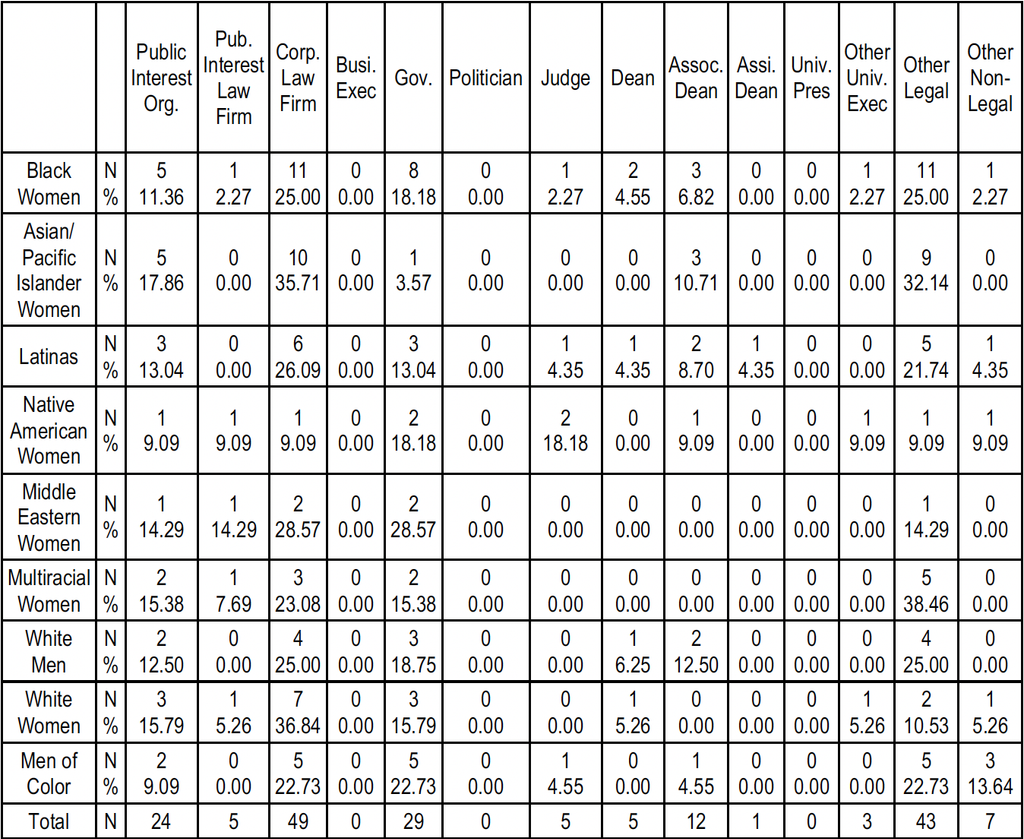
As formal administrative leadership is one of the specific domains tracked to ensure a representative sample, women of color leaders are purposefully oversampled in the DLA dataset. Table 3 indicates which employment positions DLA participants have held since earning their law degrees, indicating that 4.7% of women of color in the sample have been or currently are deans (as compared to 2.2% of the women of color currently in legal academia) and 14.3% having experience as associate deans (compared to 11.5% nationally).73The DLA sample purposefully oversampled academics who had served in leadership positions in order to have meaningful representation of people in those roles.
Table 3. Positions Held Since Earning JD, by Race &
Gender, DLA 2013 (N=93; multiple entries accepted)
B. Drawing from Current Challenges & Opportunities Current challenges in legal academia signal both pitfalls and opportunities for women of color in legal academia. On the one hand, diversity in legal academia may drop precipitously, to levels unseen for decades. As traffic slows through the law school pipeline, preparing fewer students to become attorneys—let alone law faculty—many talented college-educated individuals from diverse backgrounds are pursuing alternate careers.74Debra Cassens Weiss, LSAT test-takers continue to decline, American Bar Associa– tion Journal, http://www.abajournal.com/news/article/lsat_test_takers_continue_to_de cline_october_number_is_at_lowest_point_sinc (last visited Nov. 11, 2014). The medical field seems to be specifically targeting some college students who may in years past have pursued a career in law by revamping the Medical College Admissions Test (MCAT) to include a new section on “Psychological, Social, and Biological Foundations of Behavior,” weighted equally with three other sections focused on Chemistry, Biology, and Critical Analysis. See How is the New MCAT Scored?, Ass’n of Am. Med. Coll., available at https://www.aamc.org/students/ applying/mcat/scores/421044/how-is-the-new-mcat-exam-scored.html (last visited July 7, 2015). Concurrently, opportunities for new scholars to join legal academia will likely continue to drop, as institutions of legal education try to evade the costs of hiring new faculty and place even greater emphasis on the traditional elite credentials—top-10 law school, law review selection, postgraduate judicial clerkship, etc.—that are so often outside the grasp of attorneys of color, even those who would become excellent academicians.75Jones & Smith, supra note 3. With tenure being called into question76ABA Committee Discusses Tenure Requirements and Law School Accredidation, PrawfsBlawg, http://prawfsblawg.blogs.com/prawfsblawg/2013/04/aba-committee-discusses -tenure-requirements-and-law-school-accreditation.html (last visited July 9, 2015). and retention an ever-present concern for junior and other non-tenured faculty,77Barnes & Mertz, supra note 31, at 512. the faculty of color overrepresented in lower-prestige positions may bear the brunt of the legal education contraction as schools downsize.78Young, supra note 25.
On the other hand, there are unprecedented opportunities for law faculty of color to step into leadership positions. With increasing numbers of the current predominantly white male deans stepping aside, legal academics from diverse backgrounds may be poised to take their place.79ABA statistics show that 78% of current Deans and 79% of current associate deans are white (see American Bar Association, http://www.americanbar.org/content/dam/aba/ad ministrative/legal_education_and_admissions_to_the_bar/statistics/ls_staff_gender_ethnicity. authcheckdam.pdf) (last visited Nov. 2, 2014). The challenges accompanying these new roles may be overwhelming, but perhaps faculty of color will rise to confront them, assuming they are both interested and welcomed into those roles. These questions are tested and answered in this Article using the data available through the DLA project.
This Article reports on findings regarding barriers in legal academia, including individual or self-imposed limits as well as both outright and subtle forms of discrimination. Coupling these individual and structural barriers with the current decline in job opportunities for entry-level candidates, women of color will likely have even fewer opportunities for securing tenure-track positions in legal academia. Although current openings for formal leadership positions should lead to increasing numbers of women of color in formal administrative roles, barriers to advancement may thwart progress in that arena as well.
Empirical findings from DLA show that there are ongoing structural barriers preventing entry for women of color into legal academia. While external forces have created additional leadership opportunities in legal academia, senior female faculty of color are sometimes reluctant to assume those responsibilities in part based on individual concerns that are rooted in structural constraints.
III. Barriersto Entry While the lack of diversity in legal academia is clearly problematic
this Part presents DLA data revealing how structural barriers continue to prevent access for women of color into legal academia. Other literature has shown that racial and gender disparities in legal academia cannot be blamed on a lack of either applicants or qualified potential candidates, as the pool of possible law professors contains significantly higher percentages of both women and people of color than are in law teaching today.80See Deo, supra note 32, at 359-64, (explaining how disparities based on race and gender “cannot be explained away by suggesting that the pool of applicants seeking positions in legal academia is non-diverse”.)
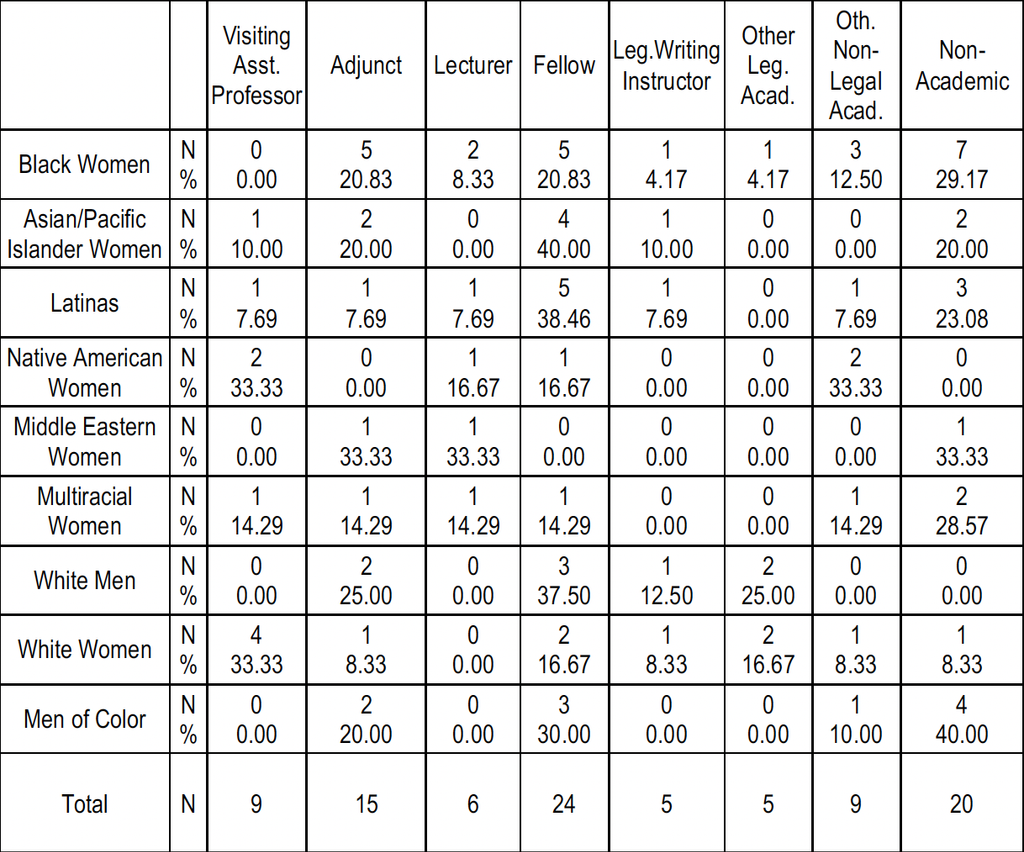
A reliance on credentials may account for part of the disparity, especially as law schools are less inclined to hire those who lack an elite law school education, did not pursue or attain judicial clerkships, and collect other markers along the traditional path to the legal academy (see Tables 4 and 5). Table 4 shows that 38% of Black women, 47% of Asian Americans, 42% of Latinas, and 20% of Native Americans from the DLA study clerked before entering the legal academy. While some of these percentages are quite high, especially as compared to the percentages of law school graduates who secure those prestigious opportunities, they are astonishingly low when compared to the 100% of white male law professors and 82% of white female law professors in the DLA study who clerked. On the one hand, this signals progress in legal academia, as it indicates that law schools are willing to hire women of color who do not have this one traditional marker of expected success in the legal academy. Yet, Table 5 explains more of the story. While the majority of women of color did not clerk after graduation, many worked their way up from less prestigious adjunct or lecturing positions to tenure-track employment while others secured prestigious fellowships and scarce visiting assistant professor positions to signal to future employers that they would be able to succeed as tenure-track professors.
The qualitative data presented here—drawing directly from the words of current law faculty participants in the DLA study and presented below using pseudonyms of those participants—explore these barriers further.
Table 4. Judicial Clerkshipsbefore Tenure-Track Position,
by Race & Gender, DLA 2013 (N=92)
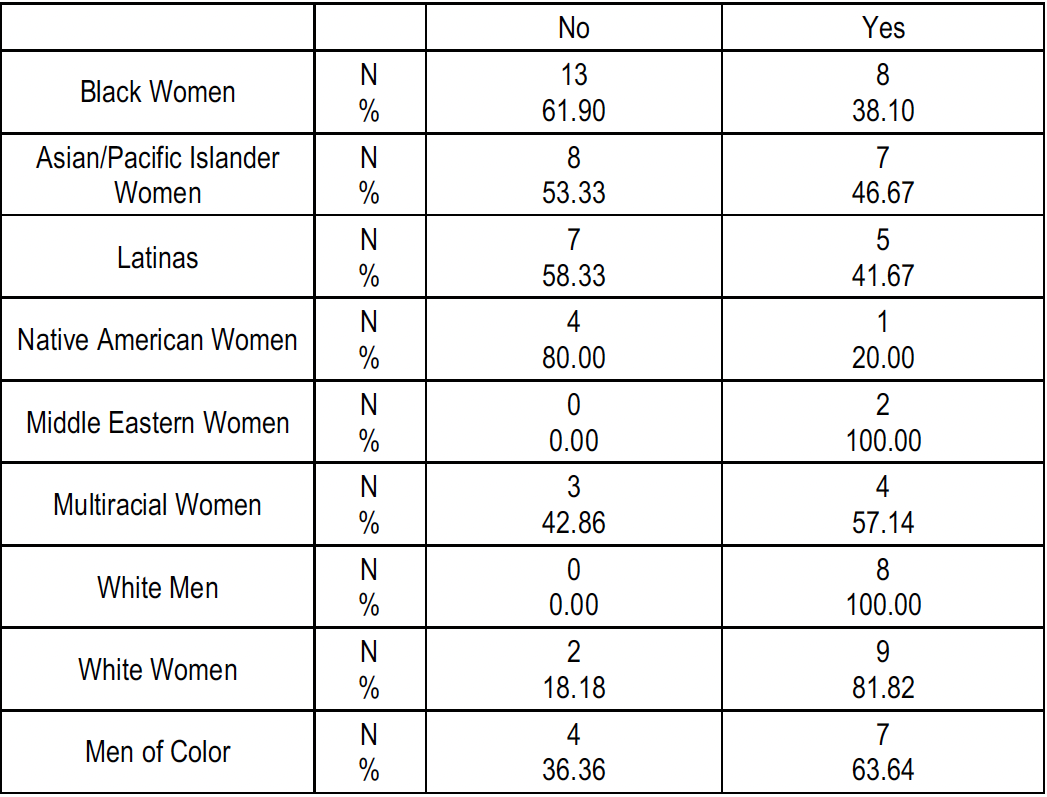
Table 5. Employment before Tenure-Track Position, by
Race & Gender, DLA 2013 (N=93; multiple responses
permitted)
Faculty hiring tends to be one of the areas most fraught with tension in legal academia for existing faculty of color and female faculty. A multiracial woman named Grace, who was a recent lateral hire at her institution, provides an example that is a case in point. Grace notes that a particular reason that she has a good relationship with everyone at her new school is because they have not yet engaged in the heated conversations that often characterize faculty hiring decisions, many of which deal with diversity issues, with faculty of color pitted on one side and white faculty on the other. Grace says, “I have no issues that I personally have with anyone. To be frank it’s probably because we haven’t gone through a recruiting season yet. I find that going through a recruiting season can often change your views of some of your colleagues.” In fact, the hiring process is often characterized by an emphasis on elite educational and professional credentials that have never been shown to relate to success in legal academia, as well as overt and subtle discrimination in the hiring process itself.
A. The Road Not Taken
Law faculty hiring begins with the tendency to focus overwhelmingly on formal and elite credentials, none of which have been proven to even correlate with future success in the profession. For instance, over 40% of current law professors attended either Harvard or Yale for law school and the vast majority (over 85%) of current law professors attended one of twelve elite law schools, regardless of where they themselves currently teach.81Paul Campos, A Failure of the Elites, Lawyers, Guns & Money (July 23, 2013), http://www.lawyersgunsmoneyblog.com/2013/07/a-failure-of-the-elites#more-46121 (“[A] study of entry-level tenure-track hires between 2003 and 2007 found that, out of 466 hires, 40.1% came from just two schools: Harvard and Yale (85.6% came from a total of 12 schools).”). AALS statistics show that 62% of law professors are men and at least 71% are white; thus, most law professors today were educated primarily by white male law professors.82See supra Table 1. Since women of color law students have so few faculty role models who share their race and gender background, few even consider law teaching as a viable option. Rarely do women law graduates of color see themselves in the role of law professor. In fact, even women of color who are currently legal academics rarely saw themselves in the roles until they entered the academy themselves, based on the statistics of current and former law faculty members.83See AALS Statistical Report, supra note 5 (providing statistics on law faculty members by race and gender).
As Karen, a Black lesbian, states, “I am not one of those people who planned at all to go into teaching.” In fact, the vast majority of faculty of color participants from the DLA study stepped into the position somewhat by happenstance. For example, a Native American female law professor named Jennifer never had a strategic plan to become a law professor; instead, she says, “I just accidentally fell into it.” A number of women of color said things similar to Cindy, an Asian American DLA participant who marveled about her pathway to legal academia. Cindy states, “It was a real freaky kind of divine intervention. I just really lucked out.” Thus, many women of color were not on a clear path to the profession from law school or earlier, but moved from practicing adjuncts, to visitors, to tenure-track faculty. When asked if anything from her childhood or law school years prompted her to consider a position in legal academia, a Black female named Danielle explains:
No, it was by luck. I was a practicing attorney and had just had a newborn and we moved [to town] and I got a job teaching at a different institution in [town] and from teaching there kind of got, I guess, the teaching bug. But I wasn’t quite in the Law School, I was in [another] Department. And then I started learning how one becomes a law professor because my study and my track was different—although I do have a Ph.D., my study and track was different at that time as to what would be required to get a tenure-track position [at that Law School]. So it was just by luck, merely by luck, that I went to the cattle call [the AALS recruitment conference] in D.C., and there you go.84Yale Law School, http://www.law.yale.edu/academics/candidates_aals.htm (last visited Aug. 26, 2013) (“The vast majority of new law teachers, both academic and clinical, are hired through the annual Faculty Recruitment Conference sponsored by the Association of American Law Schools (AALS).)”
Because most women of color do not see themselves in these roles while law students, becoming a law professor does not seem like a viable option. As an Asian American named Leanne notes of her law school days, “I had no idea that teaching was even an option. I guess I knew it was a career, but it was never something I would even consider doing.” Because law teaching seems beyond their habitus, an unfamiliar position that seems somewhat out of reach or beyond their own sense of what is normal or seemingly acceptable for people like them, some women who are currently law faculty members applied for a position in legal academia only after they were encouraged to do so multiple times.85Habitus may be considered “[a] structuring structure, which organises practices and the perception of practices.” Pierre Bourdieu, Distinction: A Social Critique of the Judgement of Taste 170 (1984). Habitus helps identify preferences, options, and opportunities that particular individuals or communities believe are avilable to them, whether or not these encompass the actual full range. Id. Thus, believing the role of legal academic to be “out of range” for oneself, as many women of color do, will naturally limit the number who go on to pursue legal academia. A Latina named Armida was encouraged to apply for a research fellowship, one of the traditional entrees into legal academics; she says, “The first time around I said no; still, I knew I wanted to do it, but the practical side to me where I was at a major law firm, where I achieved this and the income that comes with it [made it hard to switch].” The practical aspects of a well-paying job at a prestigious firm made it hard for Armida to consider legal academia as an alternative. Yet, the person who would become Armida’s mentor was persistent. The financial disincentives of giving up a lucrative law firm practice for law teaching are especially pronounced for many women of color, who tend to come from lower socioeconomic back-grounds and have greater financial obligations to extended family.86See Meera E. Deo, Sources of Support for Legal Academics (in progress). Initially, Armida “told the person no, and he was really upset with me and he was like, ‘Ugh, fine!’ Two years after that, or maybe a year later, he con-tacted me again” and she decided to apply. Armida quickly received an offer and has been a law professor ever since.87Mentorship is key for women of color to enter legal academics with the vast majority of study participants identifying mentors as one of the main reasons they entered and remain in legal academia. This is worthy of an article all its own and is explored further in a subsequent piece drawing from DLA data See Meera E. Deo, Mentors, Sponsors, and Allies in Legal Academia (in progress).
B. Overt Discrimination & Implicit Bias In addition to the initial hesitancy of some women of color lawyers
to consider law teaching as a profession, many others face formal structural constraints in the form of outright discrimination through the hiring process. The most blatant acts of discrimination evident in the DLA data are against Muslim and Arab-American faculty candidates. For instance, an Asian American woman named Noriko recounts how a white male colleague blocked the candidacy of a Muslim applicant who interviewed for the position wearing hijab.88Hijab is a traditional head-covering worn by Muslim women based on an adherence to tradition or a symbol of their faith. See Oxford English Dictionary, http:// www.oed.com/view/Entry/257446?redirectedFrom=hijab#eid. Noriko’s white male colleage voiced his objection publicly during a faculty meeting called to discuss the candidate, and did not state any objections to her credentials, raise questions about her teaching ability, or challenge whether her scholarly agenda was sound; he simply based his objection on his general sense of discomfort being around her. As recounted by Noriko, he said, “ ‘I just wouldn’t feel comfortable having her in the office next to me.’ “ A Native American male study participant reflected on recent potential hires by admitting particular candidates might even be able to sue for employment discrimination if they knew the full story: “We’ve had visiting faculty who are Arab or Muslim who’ve been run out of town on a rail and I think it’s offensive and actionable.”
Even after particular nontraditional faculty are hired, some of their colleagues continue to act in biased fashion against them. Some colleagues attribute the hiring of particular faculty of color solely to affirmative action, assuming faculty of color are less qualified but nevertheless hired in order to satisfy baseless diversity goals.89This reflects a “surface” interest in diversity, rather than a commitment to diversity as a “core” goal. For more on core diversity, see Rebecca K. Lee, Core Diversity, 19 Temp. Pol. & Civ. Rts. L. Rev. 477, 479-80 (2010) (discussing “surface” versus “core” diversity ideals in the workplace). The stigma of being viewed as an “affirmative action hire” can also negatively color the landscape for faculty of color in legal academia, as colleagues may see them as less deserving of their positions.90See Madeline E. Heilman, The Affirmative Action Stigma of Incompetence: Effects of Performance Information Ambiguity, 40 Acad. of Mgmt. J. 3 (1997), available at http:// www.jstor.org/discover/10.2307/257055?sid=21105345808961&uid=2&uid=3739256&uid= 70&uid=3739560&uid=4&uid=2129. For instance, a senior Latino scholar named Fermin recounts a conversation he had with a white male colleague early in his career, “He told me I was only hired because I was Mexican.” At the time, Fermin laughingly countered with a caustic remark: “‘When has that ever been a positive here?!’” While Fermin came up with a humorous retort, his colleague nevertheless discounts him as someone hired because of his race, who truly does not belong or at least did not enter law teaching based on what he considers “merit.”91A discussion of the merits of redefining merit are beyond the scope of this Article, though other scholars have addressed the topic extensively. See, e.g., Richard O. Lempert et al., Michigan’s Minority Graduates in Practice: The River Runs Through Law School, 25 Law & Soc. Inquiry 395 (2000); see also Robert M. Hendrickson, Rethinking Affirmative Action: Redefining Compelling State Interest and Merit in Admission, 76 Peabody J. Educ. 117 (2001).
There are also countless instances of subtle bias and discrimination against potential hires. Usually, discrimination in the hiring context occurs through implicit bias, when “thoughts and behaviors [] ‘affect social judgments but operate without conscious awareness or conscious control.’”92Deo, supra note 11, at 12 (quoting Jerry Kang & Kristin Lane, Seeing Through Color-blindness: Implicit Bias and the Law, 58 UCLA L. Rev. 465, 467 (2010)). Often, individuals acting on their implicit biases hold “egalitarian beliefs” and deny holding any “personal prejudice.”93Id. (quoting Victor Quintanilla, Critical Race Empiricism: A New Means to Measure Civil Procedure, 3 UC Irvine L. Rev. 101, 112 (2013)). Yet, because implicit bias does not rely on conscious thought, but rather draws from the subconscious, it nevertheless “leak[s] into everyday behaviors such as whom we befriend, whose work we value, and whom we favor—notwithstanding our obliviousness to any such influence.”94Jerry Kang & Kristin Lane, Seeing Through Colorblindness: Implicit Bias and the Law, 58 UCLA L. Rev. 465, 467-68 (2010). Thus, a woman wearing hijab will make some faculty members unfamiliar with this dress uncomfortable, not because they have conscious prejudices against Muslims, and even in spite of their sincere belief that they are truly egalitarian, but simply because their subconscious reacts negatively to the image and association of a woman in hijab. Whether based on explicit discrimination or the implicit bias of being uncomfortable with someone different from the norm, the objection of a white male faculty member meant that the woman of color faculty candidate was not hired.
In part because of implicit bias, efforts to improve faculty diversity can be especially daunting. A white male DLA participant named Joe is unapologetic about the lack of diversity on his faculty, seeing it as a regular outcome of how most institutions operate; he notes, “As institutions tend to do, they’ve hired people who look like themselves.” A white female law professor named Scarlett sees this common occurrence as more problematic, worrying that diversifying the faculty is “an uphill battle because the white people, especially the men, are really holding on to their positions of power. They’re trying to bring in people like them.” Whether conscious or not, her faculty and many others are reproducing themselves, searching for faculty candidates who remind them of themselves and whom they expect will become similarly successful, though other types of success or routes to success may also be viable. Confusion also abounds about race and ethnicity. Noriko had another colleague who wondered aloud how they should categorize a South Asian faculty candidate, asking, “ ‘Is he really a person of color?’ “
C. Comparing the White Male Experience
In contrast to the experiences of women of color legal academics, many white men started on a clear path toward legal academia from their law school days, if not before. A white man named Adam says, “I only went to law school to be a law professor.” Most white men in the DLA study began cultivating the idea of joining academia when they were law students, often inspired and encouraged by individual law faculty members at their institutions. For instance, a white man named Matt says that his interest in legal academia “probably started just by admiring law professors that I had.” A tenured white faculty member named Ken acknowledges:
I was not a particularly outgoing law student at [my institution, but] in my third year I did meet a faculty member who was visiting who is extremely generous and nice and supportive who became a kind of mentor of mine. I’m quite sure if it wasn’t for his mentorship I also would’ve never become a legal academic.
Similarly, a senior white male named Christopher “attribute[s] my being in the profession largely to a teacher I had in law school for whom I was a research assistant and who encouraged me to think about teaching law as a career.” Both of their mentors were white men, like Ken and Christopher themselves. These law faculty role models likely give young white male law students an image they suspect they can follow, or a dream they hope to live up to, in contrast to women of color, who rarely see someone with a similar name, face, or background at the front of the classroom to inspire and guide them.95See AALS Statistical Report, supra note 5.
Sometimes, mentors go above and beyond for their mentees. Obviously, this may happen regardless of the race or gender of the mentor or the mentee, though white male law students may be more likely to have powerful white male law faculty mentors, sponsors, and allies. Christopher’s mentor, who first inspired him to consider law teaching, also “recognized that having [a] clerkship was something that enhances your status as a law teacher;” the mentor therefore arranged a clerkship for Christopher with a judge he knew personally. In addition, Christopher’s mentor “actually arranged with [a top-five] Law School to grant me a teaching fellowship,” another instrumental step along the traditional path to legal academia. Though most mentors have less powerful influence over the trajectories of their mentees, many outline a strategy geared toward legal academia, including clerkships, publishing, or other particularly useful credentials for breaking into legal academia. For instance, a white male named Joe notes that although he “got out of law school and had no idea what I wanted to do,” he had applied for and accepted a clerkship because his mentors all “said, “‘Clerk! It’s such a wonderful experience.’ “
Many white law students, law faculty candidates, and new law profes-sors recognize that they benefitted from other advantages, whether family connections or broad social and cultural capital, that helped them along their trajectory. Joe continues that when he received his first offer he was unsure whether to take it or consider an alternative offer that was not on the tenure track. Some women of color candidates may have an attorney colleague or mentor to rely on; Joe could solicit advice from immediate family as well as professional mentors: “My mom was a lawyer so I had people to talk to. Everyone said, ‘You don’t need to go any further. You take the one that is tenure-track.’” Christopher, whose mentor helped him secure a clerkship as a new law graduate, has paid that forward to his own kin, arranging a clerkship for a family member who is now a legal academic because the judge “was a close friend of mine.” Neither Christopher nor others in the DLA study discussed making similar arrangements for women of color law students who were aspiring legal academics. None of the women of color in the DLA sample discussed having family mem-bers make similar arrangements for them, likely because there have been so few law faculty of color over the years who could make those sorts of grand gestures and provide that level of sponsorship.96See Deo, supra note 11.
IV. Barriersto Leadership
While opportunities look dismal at the entry level, especially as law schools further constrict, they seem better at the leadership level. Until recently, women of color holding leadership positions were exceedingly rare.97See American Bar Association, supra note 7 (current ABA statistics indicate that 83% of law school deans and 79% of associate deans are white). Trisha, a senior Black female, had been interested in becoming a dean for decades but was never successful. As a mid-level tenured faculty member, she took on various prestigious volunteer positions with AALS and other legal academic organizations, expecting those credentials would help secure her future as a law school administrator since they had been part of the path for others. Those positions she took on because “I thought that it would be a career path towards a deanship. It wasn’t. It has been for white women but not for me.” Trisha has now resigned herself to never taking on that role. She notes, “I think that in my case my desire for leadership in law schools ran contrary to the time and so I’m in my own way trying to make peace with that.”
Today though, because many deans and associate deans are stepping down, and because most people currently occupying these positions are white men, women of color could take this chance to succeed them.98Margot Slade, Women, Minorities Land Majority of New Law Dean Appointments (June 25, 2014, 2:59 PM) http://campus.lawdragon.com/2014/06/25/women-minorities-land-majority-of-new-dean-appointments/ (noting that “[f]ourteen law schools have lost their deans in the last six months” and “[o]f the 15 new deans at law schools accredited by the American Bar Association, eight are women and almost half are minorities.”). However, additional barriers may prevent women of color from fully seizing this opportunity, many of which initially seem self-imposed though they are actually constructed from larger external forces.
A. Getting Interested
from assuming leadership positions come from women of color themselves—though their origins lie with external factors. Many women of color state that they are not interested in taking on formal leadership roles in their law school’s administration. For instance, when asked if she would be interested in administrative leadership, a Black woman named April replies, “Dean? Uuugh [sound of disgust], I don’t really know that I want that job necessarily.” Melissa, a Native American legal scholar, is more emphatic, stating, “I don’t ever want to be a dean.” A senior Latina named Bianca expresses the common sentiment among women of color that even when she has been a leader, it has occurred more by accident than by design. Bianca states, “I don’t think I strive for leadership. I think I have sometimes found myself in those positions [but] it’s not like something I go after.”
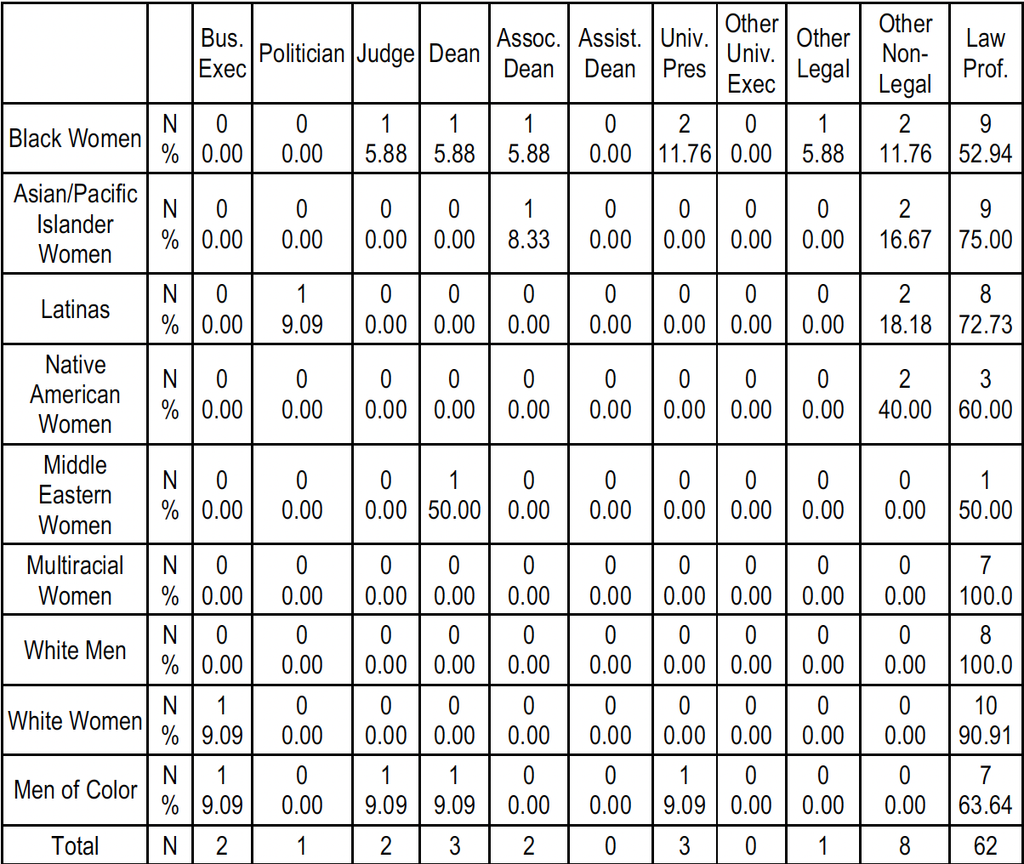
Collectively, aggregating results from the DLA survey sample, a relatively small percentage of women of color is interested in becoming a law school dean. In fact, the results displayed in Table 6 indicate that the overwhelming majority of law professors are content with their current positions as professors. Very few see a deanship as their ultimate career goal. In fact, even many of those who are associate deans do not list it as their ultimate career objective. Interestingly, white men and white women are no more likely to aspire to a role as a dean, at least as their ultimate career choice.
Table 6. Ultimate Career Goal,by Race & Gender, DLA
2013 (N=72)
Many women of color faculty note that their lack of interest in formal administrative leadership comes from their desire to focus on writing and other professional aspects of law teaching. In addition, they worry that they would be given short shrift if they turned the majority of their attention to administrative duties. Carla, a Latina, notes, “I do not want to be a dean. I’m very clear about that. I don’t want to be a dean because I much prefer writing.” Even though she has “been approached by a few institutions [asking,] ‘Would you consider putting your name in [as a dean candidate]?’” she has always replied, “‘No, I’m not interested.’”
Even young female faculty of color plan to avoid a future in leadership. For instance, Gabrielle is a Black female untenured associate professor who states definitively, “I’ve definitely never been interested in administration at a law school.” Instead, she would “prefer to spend my time in the classroom and writing.” Many other female faculty of color agree, citing their ongoing teaching and research priorities as the main reason why they would not be interested in pursuing a leadership role. As Emma, a multiracial woman in her fourth year on the tenure-track, notes, “I don’t think that becoming an administrator or leader within the institutional setting of legal academia will serve my overall long terms goals of why I wanted to become an academic and what it is I’m seeking to do.”
For still other law faculty, family obligations and interests keep them from fully considering a future in administration. Imani is a Black woman who says that “initially I definitely had a goal to one day be a dean.” However, her priorities shifted once her daughter was born. She notes:
[T]he fact that I have a daughter . . . it really has made a difference in thinking about what life would look like having that kind of administrative role on top of being the type of wife and mother that I want to be. Although it’s definitely possible to do all of that, there’s definitely conflict.
While Imani has not given up on the possibility altogether, she is firm that “right now it’s really made me pause whereas before I was on that track, but after seeing what it really entails it’s definitely given me pause.” Patrice, a Black woman, cannot imagine taking on administrative duties in addition to her current professional and personal responsibilities. Her priority now is to do good work and be an excellent parent, which is already a challenging balancing act given her hectic schedule. She notes:
It’s hard to imagine me leading anything and still being a present and effective parent. So it’s not to say that when my kids are older . . . that my priorities might change. But right now they’re my priority, like sort of being a leader for them. Like going to parent-teacher conferences, and there’s very little time for that. I feel like already I’m not doing nearly as much [with my kids] as I’d like to.
In contrast, an Asian American woman named Aarti is more comfortable taking on administrative duties specifically because her husband provides most of the childcare duties in their household. She notes that she would be “happy to take on this extra work as long [as it did not] come at the expense of the flexibility of my job.” Aarti is clear that the extra challenge of juggling work and family that would come with an administrative position seems more manageable to her now than it did before because now “my husband is a stay-at-home dad, a full-time stay-at-home dad.”
Other women of color cite politics as the reason they stay away from administrative positions. A Latina named Bianca is not interested in the administrative headaches and political battles that she believes administrative responsibilities carry with them; she states emphatically, “I wouldn’t say that I’m interested in being a leader. You know, don’t get me into [the] politics.” Similarly, a Black female named Danielle explains that she is not interested in becoming an administrator “[b]ecause it’s too political. The things that I would want to do, the things that I think a law school should do . . . it just wouldn’t work.” Some who have already taken on other administrative responsibilities are especially emphatic that they are not interested in a deanship. Elaine, an Asian American, says, “I’ve had a taste of leadership in various ways and I think what I’ve had has been more than sufficient [laughing]. I’ve been approached about being deans and stuff like that but I don’t like the politics of it all.”99In addition to these individual barriers, it is possible that additional structural barriers may prevent women of color from comfortably stepping into more formal leadership positions. Preliminary analyses of this tangential question suggests that women of color have significant family obligations, not only to their children and partners, but also to extended family including parents, siblings, grandparents, and even community or “Church family” members. Further research can investigate the extent of this structural barrier and the ways in which it compounds the individual barrier blocking the ease of access for women of color to enter leadership roles in legal academia. See Meera E. Deo, Family & Community article (in progress).
B. Structural Roots
While these reasons may seem purely individual at first blush, many have deep structural roots. When female faculty of color state that they prefer writing and teaching, they may be echoing what others have told them is their appropriate place in legal academia. Few women of color faculty have role models or examples of deans or other administrators who look like them, have names like theirs, or share their background and experiences.100See American Bar Association, supra note 7 (83% of deans and 79% of associate deans are white, leaving very few possible role models who share the racial/ethnic background of women of color).
In an interesting parallel to the many women of color legal practitioners who do not see themselves as legal academics and so do not seek out faculty positions, some senior women of color faculty are so certain that leadership positions are not meant for them that they do not even bother applying.101For more on how a lack of role models is a barrier to entry for aspiring women of color legal academics, see supra Section IV.A. The process by which a Latina named Mariana became an associate dean at her law school is sadly representative of the experience of the few women of color law faculty leaders—and makes one wonder how many more could become law faculty leaders with the proper support and encouragement. Mariana recalls that the summer before she began as associate dean, she was “in my office writing articles, [and] the call had already gone up from the interim dean [over email] whether anybody wanted to be associate dean and I didn’t even respond.” Though she had not expressed any interest in the position, the interim dean “came in my office and asked me to do it. He gave me a day or two to think about it and then I agreed to do it.” In part, the interim dean convinced her that she could be helpful in the role and promised that it would be a temporary position; Mariana recalls that “[h]e said, ‘Come on, it’s only going to be for one semester.’ Well that semester turned into almost two years.” Without this nudge, Mariana would likely never even have pursued that leadership role.
Findings presented in another article drawing from the DLA dataset have revealed the challenging faculty interactions that tend to characterize the climate at most law schools.102Deo, supra note 11. This unfriendly climate also explains why an Asian American named Cindy and others like her believe that they should not take on administrative tasks. Cindy notes, “I think I don’t do well trying to manage and dealing as an administrator, negotiating anger and managing complaints, which is what I think a lot of administrators end up doing.” Imagining herself in that role, given the challenges she has already faced with her colleagues as a faculty member, she may correctly assume a difficult road as dean.
An Asian American named Annie suffers from a similar lack of confidence in her abilities to succeed as a law school dean, based largely on her own past experience in an administrative position and the ways her faculty colleagues interacted with her in that role. She notes, “I realized I’m really not cut out for that type of overt leadership for lots of different reasons. I mean that’s not to say other women can’t do it, but I just felt like it wasn’t me.” Part of why she did not feel successful at her previous administrative role was because “when I assumed that role, people respond[ed] to the role rather than to the person; [they began acting] defensive, hostile, all sorts of other [negative] responses.” Sadly, Annie internalized this to mean, “I just was not good at it,” determining now that “I don’t really belong in this [type of role].” Danielle, a Black woman, is similarly affected by the climate at her law school and in legal academia generally. She notes that legal education today is “driven by this whole notion of the stigma behind affirmative action, the dismantling of affirmative action, the whole taking a seat [that should go to a white person], the whole, ‘you’re not qualified’ [assumption].” In her experience, “when I sit in meetings and hear admissions reports and hear what people have to say . . . all of that background just clouds all institutions.” She worries that “this whole cloud of negativity . . . would just frustrate me on a daily basis” if she were a formal leader, and would likely drive her out of legal academia altogether.
It is clear that there are limited role models and many negative experiences with faculty colleagues; in addition, of the few women of color who have been deans, many have highly publicized challenges and trials as deans that also dissuade other would-be leaders. Some of these incidents are directly attributable to the intersection of their race/gender.103For instance, one of the DLA participants referenced the highly publicized lawsuit filed by a white male faculty member at Widener Law School against the school’s Black female Dean Linda Ammons (which was filed after the white male faculty member used hypotheticals in class about him shooting Dean Ammons and naming her as a drug dealer). Widener Law Professor Settles Lawsuit with School, Nat’l Jurist (Feb. 8, 2012), http://www.nationaljurist.com/content/widener-law-professor-settles-lawsuit-school). After settling the lawsuit, Dean Ammons, who was “both the first female and first African American dean of the law school,” first took a sabbatical has more recently retired from law teaching. Robin Brown, Ammons Steps Down as Widener Law Dean, Delawareonline (Apr. 29, 2014, 11:00 PM), http://www.delawareonline.com/story/news/education/2014/04/29/ammons-steps-widener-law-dean/8495405/. Patricia, a Black woman, is ambivalent about becoming an administrator because she does not feel like she would be set up to succeed after seeing other women of color deans attacked and made to fail. She admits, “I have wanted that in the past,” but now says, “I don’t know. I don’t know about leadership.” When pressed about her reasoning, she elaborates that she is not sure that the environment would be one supporting and facilitating the success of non-traditional leaders:
It’s complicated being a woman of color and being a leader. It’s very complicated. I’m not sure that the world is ready for women of color deans. There are successful women of color deans, a few; there are many more that go down in flames and the stories about women of color as deans, some of them are just so ugly. And I’m not sure that I want to subject myself, my family, to that sort of ugliness. [By “the world,” I actually mean that] it’s American law faculties [that] are not ready, meaning race is still such an issue that law faculty members don’t want women of color, Black women especially, in positions of power over them. I didn’t say “in control” because you’re not really in control of these cats [even if you’re dean].
In these various ways, even seemingly individual reasons including a lack of interest or unwillingness to consider leadership responsibilities come from broader structural constraints keeping women of color from advancing in legal academia.
C. Discrimination
In spite of these challenges, some women of color are interested— and even passionate—about becoming leaders. When asked directly if they were interested in assuming leadership positions in the future, a few DLA participants answered, “Definitely,” “Absolutely,” or, as a Black woman named Kayla, notes, “I would love to be a dean someday.” Perhaps Kayla and those sharing her ambitions will step forward to fill the void left by the white men currently leaving those positions. Laila, a Middle Eastern woman who is as-yet untenured but thinking of her long-term plans, is a case in point, exclaiming, “I would love being the first Arab American dean of a law school.” Some of these women even have a sense of duty to pursue leadership opportunities. For instance, a Black woman named Karen says:
There’s a part of me that wants it because I think it’s really important for people like me to be in leadership positions in law schools. . . . People like me meaning women, people of color, people who are accomplished scholars, but also are very focused on teaching. People who are appropriately skeptical of the law school enterprise, but also respected.
Balanced against this responsibility to lead, Karen is aware of the challenges she would face, noting, “On the other side of it though, on a personal level, I’m not convinced it would make me happy.”
For those women who are interested in pursuing these increasing leadership opportunities, ongoing discrimination continues to serve as an obstacle barring their advancement. Jane, a multiracial woman, explains how women of color tend to be overlooked for these positions in the first place, even if they are interested. She says that when a new white male dean started at her law school a decade ago, he selected a white male faculty member to become associate dean. Recently, when Jane’s faculty was involved in another dean search and a new associate dean was being chosen, “it occurred to me and [another woman of color on my faculty] to say, ‘We already do a lot of this work, but we aren’t getting any of the recognition.’” Thus, they are overlooked for the formal leadership positions, though they tend to do much of the work already. Jane noticed a similar attitude among her faculty toward a woman of color who was among the candidates to become the new dean, recalling, “I don’t think anyone ever really saw her in that [role], saw that, ‘Oh, this could be a dean; this could be someone in administration.’” Just as students tend to prescribe a presumption of incompetence to non-traditional faculty—especially white women and women of color104Gonzalez & Harris, supra note 44.—some faculty extend a similar sentiment to women of color, whether colleagues or external candidates seeking leadership roles.
D. Comparing the White Male Experience
In contrast to these experiences, a few white men in the DLA sample seem clear about their interest in leadership from an early stage and are more direct in pursuing these leadership goals.105While the quantitative data do not indicate that white men are any more likely to be interested in pursuing formal administrative roles as their ultimate career goal than are white women, individual white men did discuss their interest and experience as leaders during the qualitative portion of the study. Data from these interviews is thus presented here in support of the theory that white men are more interested in pursuing formal leadership roles. Others can see themselves in the role of a leader, even when they are not currently pursuing those positions. Most importantly, those in power seem to see white men as a natural fit for leadership positions too.
For instance, a white male DLA participant named Christopher says that “through high school and college I was always the class president or fraternity president, all of that sort of thing. I was one of the two top officers on Law Review and that seemed to be something I naturally gravitated to.” More importantly than even his own interest, or perhaps an impetus for it, was that “people sort of acknowledged I was somebody that would be an appropriate leader for whatever they were doing.” This external validation likely cemented Christopher’s interest in leadership, as contrasted against Annie’s internalization of the sense that she does not belong in leadership based on her previous experiences interacting with colleagues when she has taken on those roles.106See supra Section IV.B. Christopher did assume a formal leadership position at his school early on, a role he continued for many years.
Although Joe, a white man, is “not seeking” a deanship at the moment, he is “not ruling a dean out [since] maybe this opportunity will become available down the road.” He seems to recognize it as a possible outcome for his future, even though he currently does not “have plans to pursue that.” He bases this possible future as a dean on the experiences of law faculty at other schools, whom he has noticed, will “suddenly become an associate dean and then they’ll go for a deanship somewhere.” He admits that “in some ways I’ve been surprised by some of the people who’ve done it. That’s why I said I’ll never rule it out. Down the road I might go for something like that.” Contrast Joe’s straightforward belief that a leadership position may be in his future, whether he actively pursues it or not, with Trisha’s direct pursuit of leadership without success.107See supra Section IV. In addition to advancement through leadership, another relevant theme of advancement is the opportunity to move laterally to an institution with a better rank-ing, according to U.S. News & World Report or other factors. Though DLA did not ask directly about lateral moves, a few participants discussed their experiences directly. The most relevant here is Surya, an Asian American woman, who expected when she had two law review articles in her first few years of law teaching published in top-5 law reviews that she would have opportunities to move. She says: And I know thought that because other people who did that they said, like they called me to congratulate me when I got an article and said “Oh [snap] when I published at Stanford for my first article that was my ticket out to Columbia. That was my ticket to places.” And they did go to those places and I didn’t. Though she does not have a definitive reason for why she did not receive the offers she expected in spite of her stellar publication record, she notes that, “people of my race and gender have published really well, but they didn’t move. They didn’t go beyond whatever institution they were in.” She notes although there are “so few Asian Americans at top law schools,” there are nevertheless “Asian Americans publishing well and getting good reviews on their work and teaching well and winning the teaching awards and yet they’re not getting ahead.” Surya’s observations about how excellent publication records yielded lateral movement for many but not for Joe also sees the position of dean as clearly within his reach; not only has he not ruled it out, but he sees others like him (in terms of race and gender) whom he deems to be less qualified attain those positions themselves with seemingly little effort.
Joe’s observation and expectation teach us that perhaps even more important that the direct pursuit of leadership by white men is that they see themselves in leadership positions, and that others do too. For instance, Ken is not directly pursuing leadership but sees it as a personal goal to help “the people around me and the whole place to succeed, and so I invest a lot of energy and time in that project which I guess sometimes leads to leadership-type roles.” His investment is noticed by others, and often recognized by those with power who then reward him with formal leadership roles. Ken’s experience is very similar to that of Ian, a white male at another institution who is untenured but already an associate dean. Ian says that he started off very invested in service work at his law school and being “heavily involved in just trying to be a work horse in most of the commit-tees I was on.” When he came to realize it might be too much for him to continue as a junior faculty member, he considered doing less. Yet, his dean had taken notice of his service work and suggested that instead of scaling back, Ian could “continue doing what I’m doing and maybe do a little bit more in terms of harnessing some of the energy of the faculty and helping them move forward.” He was subsequently offered the associate dean position as formal recognition of his service work with the expectation that he would continue and expand it in exchange for fewer teaching obligations and greater pay.
V. Strategies for Improving Recruiting and Advancement
Clearly there are barriers to entry and advancement in legal academia preventing women of color from flourishing as law faculty members and leaders. The DLA participants themselves provide a number of suggestions to improve recruiting mechanisms to diversify the legal academy from the lower ranks of professors to the upper echelons of formal leadership. Many of these suggestions are not new, but have been stated by other scholars in personal conversations and professional publications.108For additional suggestions to diversify legal academia and improve the climate for law faculty generally, see Deo, supra note 11; Gonzalez, supra note 44; Barnes, supra note 31. What is unique about this Article is that these mechanisms are proposed not only as theoretical solutions, but as empirical suggestions to achieve success.
A. Reach Out To overcome challenges in recruiting and advancing diverse faculty,
we must first directly encourage female attorneys of color to consider legal academia. This will create more purposeful legal academics, so that we do not simply rely on “accidents” to get women of color through the door. We can also expand our definitions of merit beyond elite educational credentials, law review service, prestigious clerkships, Ph.D.s, Visiting Assistant Professor positions, and Fellowships. Arguably, none of these directly correlate to success in legal academia. Yet, most schools are unwilling to consider candidates from any but the top few law schools, let alone a school outside of the top tier, especially if the candidate has not accrued other educational credentials. Brianna, a senior Black scholar and administrator, states, “I think there needs to be greater outreach toward those of us [women of color attorneys] who are in-house or in government positions or in firms.” Otherwise, legal academia may be missing scores of qualified candidates who “don’t really know how to break in to the academy” since most successful candidates follow “this traditional pipeline of law school, clerking, academy, or law school, fellowship, academy.”
Law schools should utilize novel and creative recruiting tools to get diverse candidates in the door, to entice them away from practice and into the academy. For instance, a white woman named Sydney says that her law school “found me through an out-of-the-box recruiting strategy” that seemed to rely less on elite credentials and more directly targeted potential faculty candidates who were already interested in scholarship as well as the region where her law school is located. A Latina named Mariana recounts that “the [most recent] person of color we hired” at her law school is someone that her associate dean met “at an Intellectual Property cocktail hour,” where “they spotted her, found out who she was, and [asked whether she was] interested in teaching.” Mariana conducted an initial screening interview, the candidate “was [then] given an opportunity to give a job talk, and she got a job.” This candidate “didn’t go through the AALS [formal recruiting process] at all,” and “now she is a wonderful scholar at our law school.” Mariana warns that those schools truly committed to diversifying the faculty “cannot rely on the AALS; it’s not enough.” If more law schools had strategies in place specifically to reach women of color, women of color would likely comprise more than 7% of current law faculty.109AALS Statistical Report, supra note 5.
B. Remodel the Pipeline
Jennifer, a Native American law professor, suggests beginning recruiting efforts even earlier: “I think we should start earlier. I think we should start helping people in law school think about this career.” That might have helped Jennifer enter law teaching earlier, since “[i]t wasn’t until I was out of law school five years that anyone even approached me about the possibility.”110Note that Jennifer also benefitted from meaningful outreach, the first proposed solution discussed in Part VI.A., even if it occurred five years after she completed her law degree. As a student, she says that it “never even occurred to me” to consider law teaching. Again, because there are few role models sharing their racial/gender background, many women of color law stu-dents do not even consider law teaching as a feasible option. Hannah, a multiracial woman, also believes that there is a pipeline problem, suggesting, “To increase the recruitment, you need to fix the pipeline because right now there is a decreased number of women entering into law school and a decreased number of women of color entering into law school.” Coupled with fewer openings for entry-level hires, and law schools being less wiling to take what they consider to be “risks” on candidates whose experiences do not perfectly fit the traditional profile of a law professor, opportunities for women of color candidates are minute.111While existing scholarship has shown that the lack of diversity in legal academia cannot be attributed to a pipeline problem, this solution is included here for two reasons. First, this solution, like all of those presented in this Part, is drawn from the data, one that DLA participants suggested directly. Second, to the extent that the pipeline can be fully stocked with overwhelming numbers of qualified women of color candidates, it truly will become harder for even stalwart naysayers to ignore their presence or refuse to hire diverse candidates.
Destiny, a senior Black scholar, does encourage her students to consider law teaching and sets them on a path that leaves the door to academia open. She says:
[W]hat I do is mention to women in general and women of color in particular, “Have you ever thought about working in the academy? How do you distinguish yourself? Let’s talk about doing some writing,” you know, “getting on Law Review if you can. Let’s talk about writing some articles. We can develop this paper, do you want to do it? Because this is going to set you apart. This can give you more options in the future, like you might want to teach. You might want to go into the academy, so let’s see if we can write something that can get published.”
Destiny stresses that “those kinds of conversations” and especially “getting them when they first come in [to law school and] really mentoring them [even by simply saying], ‘Here are three things that you should do for yourself . . . that are going to give you more options later,’” can truly help. Unfortunately, she says she doesn’t “think that happens much and that’s part of the reason why you have so few women” in legal academia. In fact, an Asian American woman named Vivian credits just this type of support with piquing her initial interest in joining law teaching and supporting her through the process of entering legal academia. She says, “When I was in law school I was made to feel by my professors like I had something important to say,” though she admits that overall “it’s so easy for that message not to be communicated.”
C. Overcome Bias Vivian also warns that “people have to deal with their own institutional bias and their own subconscious bias” before greater numbers of diverse faculty will apply, be hired, and succeed in legal academia. When people create their own narratives explaining “why the white guy hasn’t written as much as opposed to the African American,” she sees “completely different narratives, like, ‘Oh he’s been so busy developing his economic theories’ [for the white candidate,] as opposed to, ‘I don’t think he’s capable to do the level of work’ [for the African American].” When “people tend to look for people like themselves subconsciously,” diversify-ing faculty and providing mentorship become more challenging. Whether based on overt or implicit bias, discrimination persists in the hiring and promotion of law faculty of color and female faculty. A response is sorely needed in order for improvement to take place. Discrimination could be addressed through focused attention on the part of the faculty and current leadership, or through formal diversity training and other programming drawing attention to the local problems and suggesting institution-specific solutions to address them. Either way, this will create opportunities for law faculties to overcome biases and diversify their ranks. The assumption that women of color, including Jane and her colleague, are not suited to formal leadership positions although they already do the bulk of the work expected of those leaders is just as bad as overlooking them altogether; either way, bias works to prevents the advancement of women of color to these administrative roles and must be overcome in order for women of color to succeed in the legal academy.
D. Be a Mentor Mentorship can go a long way toward helping faculty candidates be
successful on the law teaching market, and could be similarly helpful in moving senior faculty into leadership positions. As a white male participant of DLA named Joe states so well, “I think having a mentor is invaluable, absolutely.” He references his own mentorship through the teaching market, explaining, “You learn so much from your mentors. [N]ot only did [my mentor] make me a better writer, teacher, and thinker, but also she knows how the whole game is played. . . . All the unwritten rules and subtleties of how to break into the profession, she knew.” A senior white female scholar named Abigail agrees, stating, “Mentors have been hugely instrumental, [proving] a glimpse of my future self and cautionary tales and advice. I was very lucky to have superb mentors.”
Yet, mentors are less common when women of color recount the trajectory of their professional lives. The women of color who have men-tors are exceptionally grateful for the opportunities that those relationships created.112For more on mentorship and other forms of support given to and given by women of color law faculty, see Deo, supra note 87. For instance, an Asian American named Lori said that while she was employed as an academic fellow and on the law school teaching market, her mentors “had the whole machinery set up to basically launch me,” resulting in her successful entry into the profession. To facilitate the success of candidates who are women of color, mentors from all racial/ethnic and gender backgrounds must support, nurture, and promote them. As Emma, a multiracial woman notes, “You have to have mentors. White men need to mentor people who are women and people of color just like they would mentor others.” Hanna, also multiracial, agrees, urging her fellow legal academics: “Be willing to mentor people who aren’t just like you.”
Sometimes, mentors provide that extra nudge pushing women of color practitioners to even begin thinking of law teaching. A Latina named Bianca notes that “part of how I ended up in law teaching did have to do with a phone call from a Latino law professor (who himself at the time was only one of twenty professors of color of any kind) in the year before when I was thinking of maybe going into the teaching market.” She continues, “Mentorship is really important,” but effective outreach may be the key to diversifying legal academia, since it is “really important to have someone who is committed to diversifying and then reaching out and finding ways to connect with the various places where you might find talented people.”
Similarly, an Asian American named Leanne recounts the mentorship she received when she was first on the law teaching market:
I called my federal courts professor who had been very, very supportive of me [during law school]. I didn’t know why, but he had always reached out and supported me and he immediately said, “Leanne, send me your application now! Fax it to me!” And I had already turned it in, so he called me and said, “You filled it out all wrong. You don’t put Race & the Law as your first preferred course,” and this is back in 1998 so he’s like, “That’s the death knell!” He was like, “You put Civil Procedure. You put your first year core set of courses.” And I was like, “You’re crazy.” And he says, “Ahh it’s too late. You’ve already submitted it.”
Earlier intervention may have resulted in Leanne securing a tenure-track position when she first sought one out. Instead, this mentor “advised me [toward] taking the visiting spot” that she was offered that year. Though Leanne only “spoke to him maybe twice once I got the job,” nevertheless, “he was helpful. And I understand now what he was telling me to do.” In later conversations, her mentor demanded Leanne completely focus on research in order to secure a permanent law teaching position during her second foray into the AALS process. She recounts, “He told me, ‘Short your students. Short your husband. Short your family. Short your life. Write. Do nothing but write for the next year.’” His advice paid off, as Leanne did secure a tenure-track position soon after.
Unfortunately, most women of color aspiring to law teaching lack this level of mentorship and guidance. Mentoring current faculty may be just as important in order to improve retention rates and encourage women of color to consider leadership roles. Yet, as indicated in Tables 7 and 8 below, current law faculty spend very little time mentoring other law teachers, whether faculty at their institutions or elsewhere. For instance, over 71% of current Black women faculty spend five or fewer hours every month mentoring faculty within their own institutions. Only 5% of Black women, 13% of Asian American women, and 27% of white women provide more than ten hours a month of mentorship to faculty at their institution (see Table 7 below). Lest one think that this relatively low level of mentorship for same-institution faculty is at the expense of time devoted to faculty at other institutions, the DLA data presented in Table 8 make clear that even fewer hours are spent mentoring faculty at other institutions. Only 10% of Black women faculty and 18% of men of color spend more than ten hours per month mentoring faculty at other institutions; the overwhelming majority of law faculty—regardless of race/ ethnicity or gender—spend under five hours per month providing mentorship to faculty outside of their own institutions.
Table 7. Hoursper Month Mentoriing Same-Institution
Faculty, by Race & Gender, DLA 2013 (N=92)
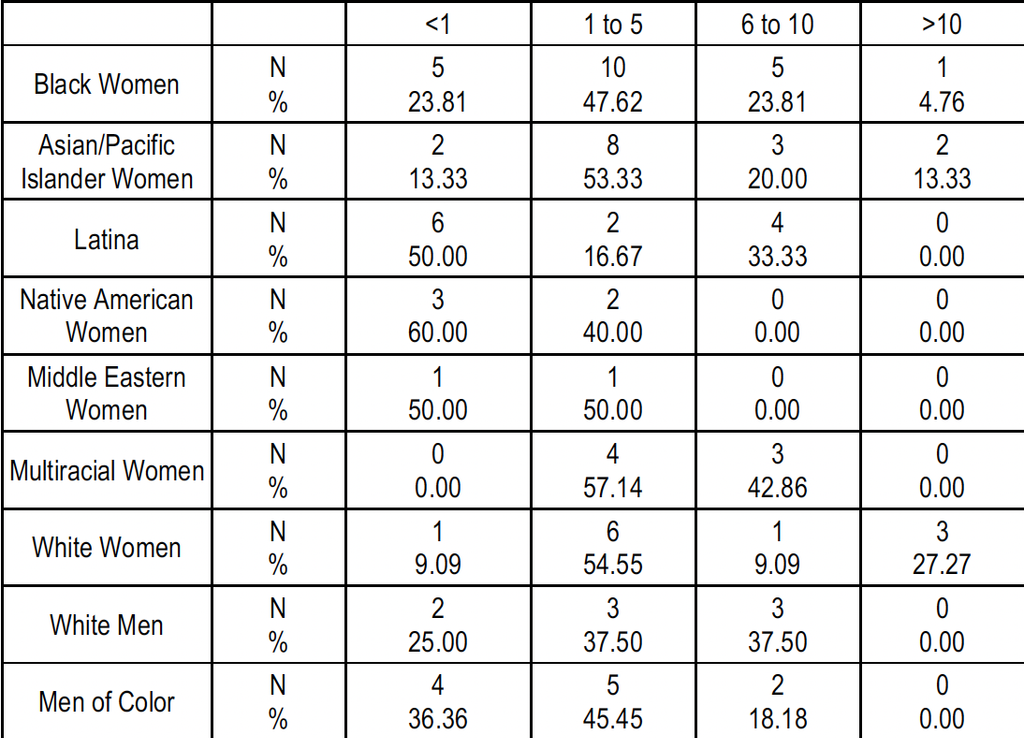
Table 8. Hoursper Month Mentoriing Different–
Institution Faculty, by Race & Gender, DLA 2013
(N=91)
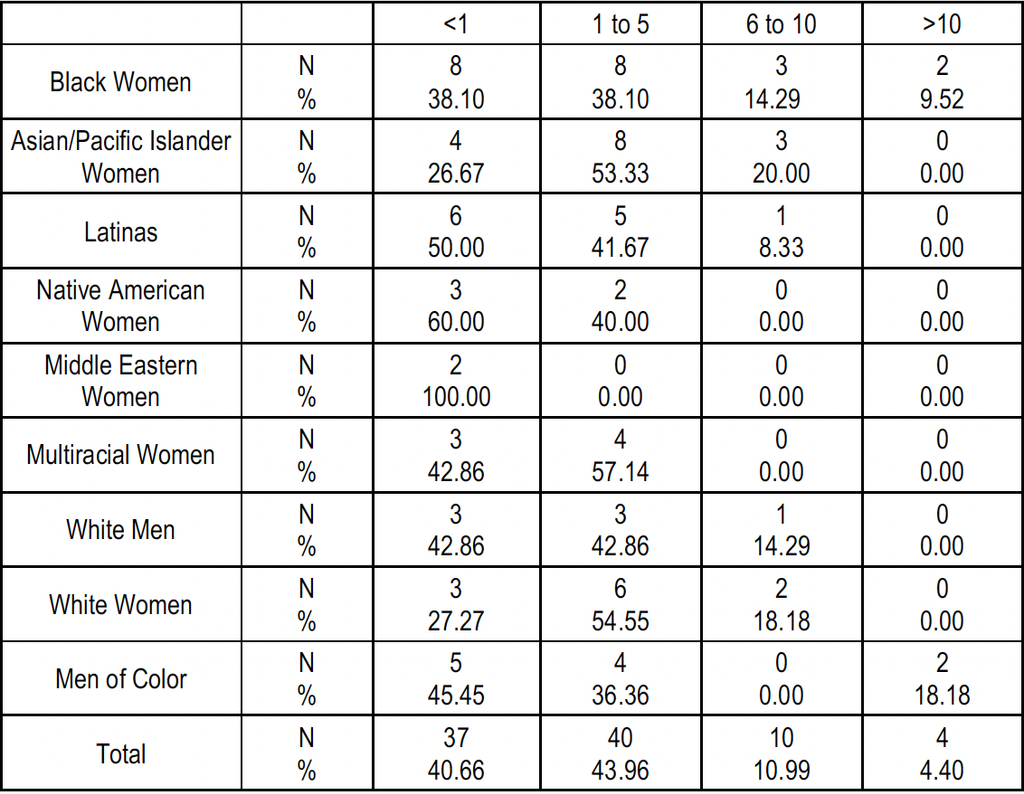
E. Just Do It
As evidenced by the solutions presented so far, many DLA participants offer thoughtful and concrete suggestions for how law faculty administrators can diversify their faculty. Yet, others stress that this is not a new problem; they feel that the solutions are straightforward for those who are truly interested in diversifying. Just as Vivian notes that some faculty col-leagues create wildly different narratives explaining away deficiencies of a white candidate while emphasizing them in an African American candidate, an Asian American named Aisha suggests that administrators should “stop finding reasons to not hire” candidates of color. She says that “oftentimes what I see in hiring situations, people will find reasons not to hire people of color and find reasons to hire white people so, you know, they give alibis to the deficiencies of white people but . . . look for the holes in [a person of color’s] record to keep [them] down.” She notes that if administrators “want to increase the number of women in academia, hire them, obviously. I mean, there’s not a dearth of applicants out there. But you have to have a commitment to do it. It’s not rocket science.” Similarly, a Black woman named April states, “I think there’s so few women in legal academia because white people won’t hire them. [They] feel for some reason that we can’t take a risk on someone who doesn’t fit [the standard] profile.” Fermin, a senior Latino scholar, makes clear that to diversify legal academia, administrations should “be on the look out all the time” for qualified potential faculty members whom they can try to persuade to consider law teaching, “and not just expect [Professor Michael Olivas] to hand you a list of people who are ready to be hired.” While the second approach is certainly easier, and readily available, it cannot be enough to fully diversify legal academia. Lola, a Latina, is perhaps the most direct: “I think you always hear administrators say it’s so hard to find a woman of color or minorities and I think that’s a bunch of bullshit. I think they purposely don’t look for candidates. It’s easier to say there aren’t any.”113An earlier article outlining the DLA project discusses the pipeline issue at length, determining that the severe underrepresentation of women of color in legal academia could not be blamed on a lack of applicants or candidates. Deo, supra note 32. Yet, since many DLA participants themselves suggested stocking the pipeline, and it is a mechanism that could increase the yield of successful candidates, it is included as a solution in Part VI.B.
Instead,as a Black male law professor named Ryan, notes, “[I]f you would like a woman of color on your faculty, then you have to go and hire a woman of color.” In his mind, it is as simple as that, for those who are truly committed. He warns, “You can’t not give it the full attention that it deserves and hope a woman of color comes your way. Sometimes you have to go out and seek lateral moves or go after particular candidates on the market.” In other words, he specifies, “To make diversity work you have to be serious and committed to making diversity work.” Similarly, a Latina named Marisol says, “[Y]ou have to care enough to want to have a diverse faculty.” But even that is not enough. In order to retain these women of color and ensure they are primed for leadership, she adds that existing law school administrators and leaders must “put systems in place to make sure that person is going to succeed.”
F. Move Beyond Collegiality
As Marisol indicates, once they’re in the door, law schools must make the environment one that is supportive and encouraging for all faculty members, including women of color and others from non-traditional pathways and underrepresented groups. Though many law faculty members describe their campus climate as generally “collegial” or “cordial,” DLA findings discussed in a separate article reveal the many ugly truths lurking just beneath this mask of collegiality.114Deo, supra note 11. As a multiracial woman named Grace urges, “Value [women of color] the way you value the white male colleagues. Treat them in that same way, give them the space to do scholarship versus spend all this time to do service,115A number of other published articles have focused on the ways in which faculty of color and female faculty tend to be overburdened by service, which stands in the way of other personal and professional responsibilities, yet rarely counts for much come time for tenure or promotion. See, e.g., Deo, supra note 32, at 369 (citing Roy L. Brooks, Life After Tenure: Can Minority Law Professors Avoid the Clyde Ferguson Syndrome?, 20 U.S.F. L. REV. 419, 420, 425 (1986). understand evaluations . . . are subjective and affected by race, gender, [and] sexual orientation.”116Existing scholarship has explained the many ways in which teaching evaluations are “biased at best, and useless at worst.” Deo, Better Tenure Battle (forthcoming Columbia Journal of Gender & Law); see also Sylvia R. Lazos, Are Student Teaching Evaluations Holding Back Women and Minorities?: The Perils of “Doing” Gender and Race in the Classroom, in Gut´ıerrez y Muhs et al., supra note 44 at 164. Without this, women of color will continue underperforming and leaving legal academia at rates higher than white and male colleagues.117See Comm. on the Recruitment & Retention of Minority Law Teachers, Ass’n of Am. L. Schs., The Racial Gap in the Promotion to Tenure of Law Profes– sors 3 (2005), available at http://www.aals.org/documents/racialgap.pdf (“[B]oth the absolute number as well as the proportion of minority law professors hired decreased in 1996-97 from 1990- 91.”). If women of color continue to leave legal academia at higher rates than others, appallingly few will be in senior positions poised to take on administrative responsibilities. One woman of color dean in the DLA study says she regularly hears from colleagues, “Oh my God, you’re crazy to be Dean.”118Since she is identified as a woman of color Dean, even her pseudonym is not used here, in order to protect her anonymity. Yet, she fears that if women of color continue to refuse to step into those roles, “then all the deans will continue to be old white men. And we cannot complain about it. And that’s the bottom line. Period.” She believes there “has to be some pipelining that’s being done towards the leadership world” or the number of deans of color and women deans will stay stagnant or even decline, in spite of the numerous opportunities presenting themselves now.
Conclusion
With ongoing changes to legal education unfolding before us, there are unprecedented challenges but also opportunities for female faculty of color. Because of constricting faculty and ongoing discrimination in hiring, there will be even fewer opportunities for aspiring female law profes-sors of color to enter the profession. The DLA data presented in this Article document the ways in which implicit bias and overt discrimination continue to plague institutions of legal education and prevent qualified candidates from assuming tenure-track faculty positions. Left unchecked, this structural barrier will thwart access for female faculty of color into the future.
Yet, there are also opportunities in legal education today, especially for female faculty of color who are more senior and established in their careers. As the white men who once held the majority of leadership positions in legal academia step down from their roles as dean and associate dean, women of color faculty may be able to step into those positions in increasing numbers. Yet, individual barriers with structural roots—reluctance to assume those roles and responsibilities because of a lack of support and encouragement to do so—may prevent this opportunity from creating lasting change in legal academia.
The Introduction to this Article emphasized how law faculty diversity could provide law schools with a critical edge: improving recruitment and retention of students from all backgrounds, providing exposure to diverse authority figures in preparation for future practice, and ensuring compliance with numerous ABA requirements.119See Introduction, infra.
Participants in the DLA study back up these assertions themselves. For instance, a multiracial woman named Emma states, “[M]y perspective of faculty diversity is that having a high degree diversity of faculty is essential to the success of other faculty members, the students, and the institution as a whole.” A Black woman named Destiny is more specific about the ways in which exposure to non-traditional authority figures is especially important for students, regardless of the students’ racial/ethnic background. She notes, “I think it’s been really important and quite startling for some of my students to have people of color in leadership positions. I just don’t think they’ve seen it [before law school].” Destiny is clear that it is important “for those students who are . . . racial/ethnic minorities, but also for the students who come from the majority” to have exposure to authority figures who are different from the norm. Specifically, she recognizes that “it’s important that they see women and get used to women in positions of authority,” even though her institution along with most others has relatively little faculty diversity as it is was “made by and for and was largely populated by white men for a very long time.”
In spite of these clear advantages to law faculty diversity, the absolute numbers of diverse law faculty remain appallingly low,120See AALS Statistical Report, supra note 5. and the qualitative experience of these individuals is equally or even more discouraging.121See Deo, supra note 11. This Article has documented serious barriers to entry preventing aspiring women of color law faculty from entering the academy, as well as those limiting opportunities for women of color law faculty to assume leadership positions. Whether dealing with a lack of role models or outright discrimination, the road traveled by women of color law faculty differs greatly from the path that many white men follow. Similarly, getting women of color interested in leadership positions is a significant first hurdle, though outright and subtle discrimination mingle with the structural roots of lack of interest to thwart improvement in the numbers of women of color in formal academic administration. Again, this differs from the normative white male experience, where leadership seems an attainable goal even if many white men also may not be directly focused on a future in administration.
In addition to discussing many challenges, this Article also proposes a number of suggestions to improve recruitment and advancement of nontraditional law faculty and law faculty leaders. To start, existing law faculty can work to mold the pipeline, encouraging law students to consider law teaching and grooming them to succeed on the law teaching market. Mentorship at these early stages should continue into the career as well, as the support of senior faculty can go a long way toward keeping junior and mid-level faculty motivated, inspired, and primed to do their best.
Beyond these individual changes, larger structural changes must also be implemented to truly diversify legal academia. Administrators and other existing law faculty should reach out beyond the traditional AALS market to affirmative seek out non-traditional lawyers who would make excellent law teachers if given the chance. While most schools present at least a surface commitment to diversity, they should ensure their actions support their assertions by hiring qualified faculty from diverse backgrounds when they do apply for positions. Similarly, administration must ensure that overt discrimination and even implicit bias do not add extra hurdles in front of non-traditional candidates. Supportive conditions in legal academia, inspired and demanded by law school leadership, can also improve retention rates for women of color faculty and others who are often marginalized and alienated in the law school setting. Perhaps then they will also surmount any additional barriers to leadership and show us the way to the law schools of the future.
